
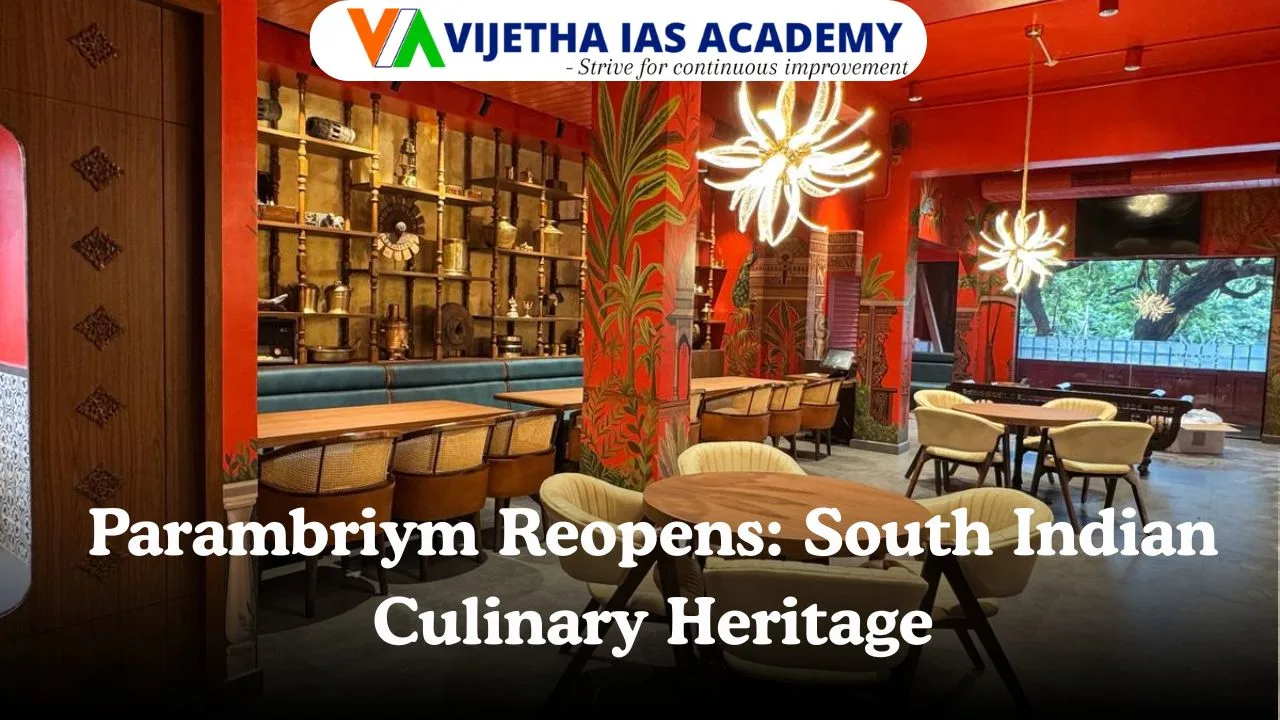
Parambriym Reopens — Reviving South Indian Culinary Heritage
Introduction
Food is not just about taste; it reflects culture, history, identity, and social values. In Anthropology, food is studied as intangible cultural heritage because it carries traditional knowledge across generations. The reopening of Parambriym, a Chennai-based restaurant, provides a strong case study to understand how traditional South Indian food cultures are being revived in modern urban spaces.
Background of the Case
Parambriym was first launched in 2014 by Anitha Sivakumar in Chennai. After a brief break, it reopened in Anna Nagar with a renewed focus on preserving and presenting South Indian culinary traditions in a contemporary dining format.
This reflects a wider trend in urban India where regional food is repositioned as cultural heritage rather than mere commercial cuisine.
Pan–South Indian Culinary Representation
Unlike the common stereotype that South Indian food is uniform, Parambriym’s menu represents diverse regional identities:
- Tamil Nadu: Madurai, Dindigul, and Chettinad cuisines
- Andhra Pradesh: Use of gongura, pappu podi, and Guntur chillies
- Karnataka & Kerala: Coastal seafood traditions
This regional mapping highlights micro-regional identities embedded in food cultures, a key concern of social-cultural anthropology.
Signature Dishes as Cultural Markers
Each dish on the menu acts as a cultural text:
- Dindigul seeraga samba mutton biryani reflects indigenous rice varieties and local spice balance
- Chettinad nandu (crab) soup shows historical connections with spice trade networks
- Andhra gongura mutton highlights the ecological use of souring agents
- Madurai bun parotta and veechu parotta represent street-food traditions entering mainstream dining
Thus, the menu works as a living archive of regional food practices.
Vegetarian Food and Cultural Ethics
The Andhra vegetarian meal platter includes items like pappu podi, gongura with ghee, gutti vankaya, rasam, and vegetable curries.
Such meals are deeply connected to agrarian cycles, temple traditions, and everyday food ethics, reflecting how vegetarianism in South India is culturally structured rather than restrictive.
Material Culture and Dining Space
Anthropologically, food cannot be separated from material culture. Parambriym’s interiors include:
- Chettinad-style carved wooden pillars
- Brass utensils
- Crimson colour palette
- Hand-painted South Indian murals
These elements transform the restaurant into a cultural space, not just an eating place.
Cultural Economy and Urban Revival
Parambriym represents:
- Heritage-based entrepreneurship
- Revival of indigenous ingredients like seeraga samba rice
- Promotion of traditional cooking techniques
This aligns with broader efforts to preserve intangible cultural heritage, similar to global recognition of food traditions as cultural assets.
Anthropological Relevance
- Food as intangible cultural heritage
- Link between material culture and tradition
- Cultural industries and urban revival
- Tradition vs modernity
- Cuisine as soft power and identity marker
Conclusion
The reopening of Parambriym shows how traditional culinary knowledge can be preserved, adapted, and transmitted in modern urban contexts. By blending authenticity with contemporary aesthetics, the restaurant becomes a site of cultural continuity, reinforcing food’s role in identity, memory, and living heritage.