
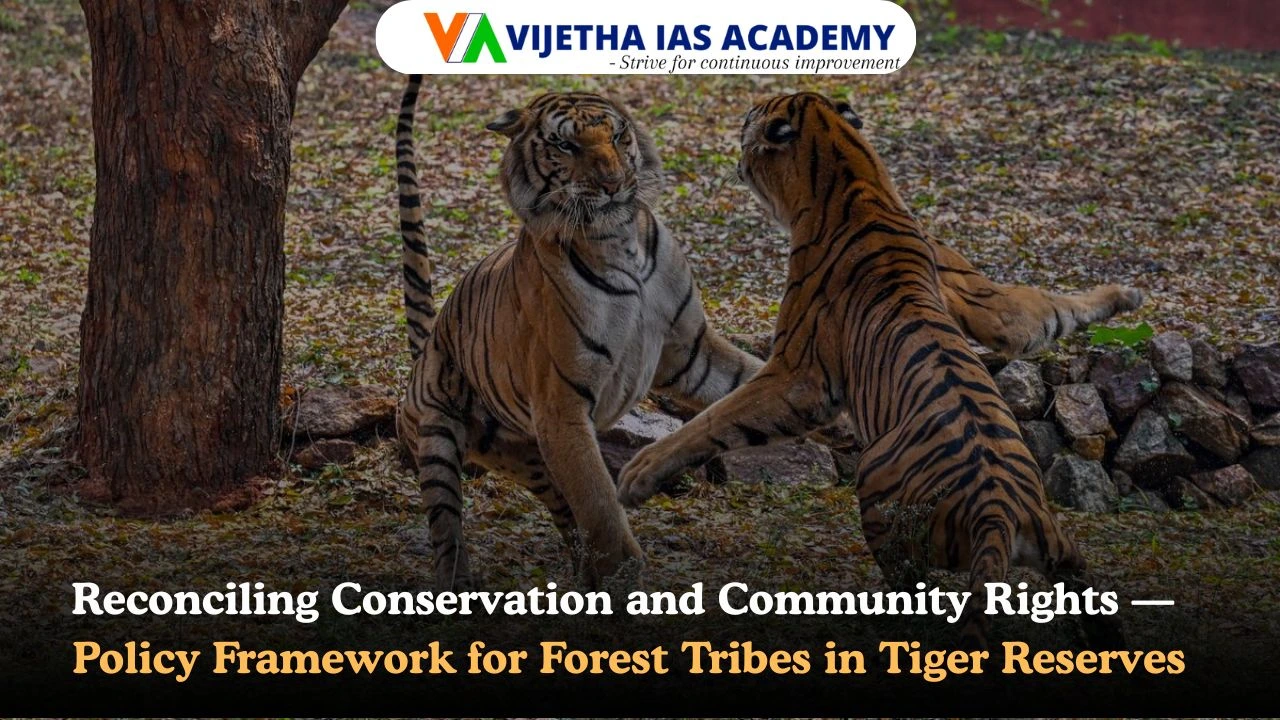
Reconciling Conservation and Community Rights — Policy Framework for Forest Tribes in Tiger Reserves
Paper and Syllabus Topic
Paper II – 6.3: Developmental projects and their impact on tribal displacement and rehabilitation; Development of forest policy and tribals.
Background / Context
The relocation of forest-dwelling Scheduled Tribes and traditional forest communities from India’s tiger reserves has raised concerns about rights violations, forced displacement, and neglect of the Forest Rights Act (FRA), 2006.
In October 2025, the Ministry of Tribal Affairs (MoTA) introduced a new policy framework after protests followed a National Tiger Conservation Authority (NTCA) directive (June 2024) that encouraged large-scale relocations from tiger reserves.
The goal was to harmonise wildlife conservation under the Wildlife Protection Act (WPA), 1972, with the constitutional and human rights of tribal communities.
Policy Framework (Key Features and Objectives)
Title: Reconciling Conservation and Community Rights: A Policy Framework for Relocation and Co-existence in India’s Tiger Reserves
Prepared by: Ministry of Tribal Affairs (MoTA), October 2025
Objectives:
- Ensure conservation efforts respect FRA, 2006 rights.
- Promote voluntary and rights-based relocations only when ecologically necessary.
- Build a community-participatory model of conservation.
Key Features:
- Relocation as a Last Resort: Only after exploring co-existence options.
- Rights Settlement First: All community and individual FRA claims must be recognised before relocation.
- Free, Prior, and Informed Consent: Required at both Gram Sabha and household levels.
- National Database (NDCCI): Tracks relocation cases, compensation, and post-relocation conditions.
- Independent Annual Audits: Ensure compliance with FRA, WPA, and human rights standards.
- Relocation Package: ₹15 lakh per family with rehabilitation and livelihood assurance.
Legal and Institutional Mechanisms
|
|
|
|
|
|
|
|
|
|
|
|
|
|
|
|
|
|
Issues and Challenges
- Implementation Gaps: FRA rights often ignored inside tiger reserves.
- Coercive Relocation: Reports of denial of basic amenities to force movement.
- Weak Coordination: Poor synergy between MoTA and MoEFCC.
- Post-Relocation Hardships: Lack of livelihood, healthcare, and education in new settlements.
- Data Deficiency: No unified national monitoring of relocation outcomes.
Significance / Anthropological Insight
This case represents a shift from exclusionary to participatory conservation — a concept central to applied Anthropology.
It demonstrates how tribal welfare, cultural identity, and ecological preservation can coexist when governance adopts a rights-based approach.
Anthropologically, it reflects the principle of “development with dignity”, recognising forest tribes as active partners in biodiversity protection rather than passive victims of displacement.
Way Forward
- Strengthen inter-ministerial coordination between MoTA and MoEFCC.
- Train field officers on FRA and participatory conservation methods.
- Establish community monitoring committees under Gram Sabhas.
- Ensure post-relocation support—livelihood, housing, healthcare, and education.
- Introduce periodic audits and public reporting for transparency.
Conclusion
The 2025 MoTA framework marks a paradigm shift from a displacement-centric to a rights-centric model of conservation.
If implemented sincerely, it could become a blueprint for inclusive environmental governance, balancing biodiversity conservation and social justice for India’s forest tribes.
Reference / Source
The Hindu (October 2025): “What’s the plan to relocate forest tribes — explained.”
https://www.thehindu.com/news/national/whats-the-plan-to-relocate-forest-tribes-explained/article70256032.ece