
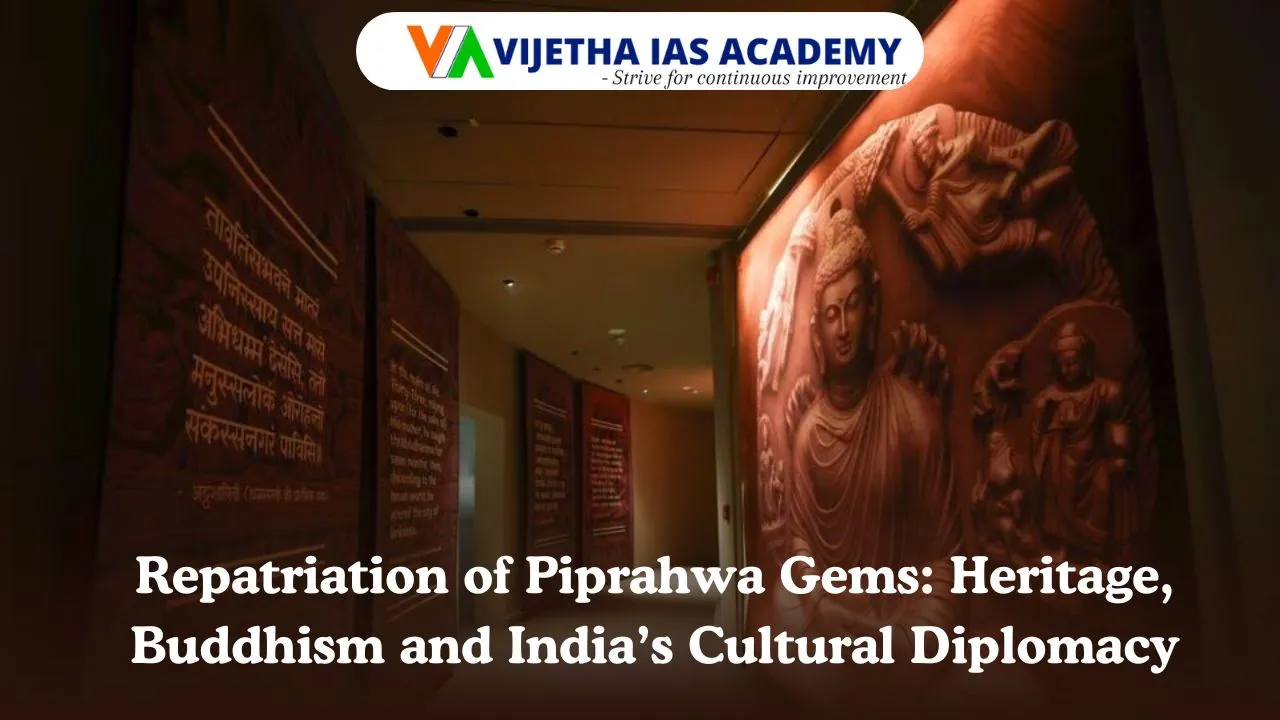
Repatriation of Piprahwa Gems: Heritage, Buddhism and India’s Cultural Diplomacy
Introduction
Culture and religion are deeply connected to people’s identity. When sacred objects are taken away, a society feels historically and emotionally incomplete. Anthropology examines how such objects influence belief, power, and memory.
The return of the Piprahwa Gems, which include the relics of Gautama Buddha, is one of the most important cultural events in modern India. It shows how heritage, religion and diplomacy come together.
What are the Piprahwa Gems?
The Piprahwa Gems include:
- 349 precious stones (pearls, rubies, sapphires, gold sheets)
- Bone fragments and ash of Buddha
- Ancient reliquaries
They were discovered in 1898 from a Buddhist stupa in Piprahwa, Uttar Pradesh, near ancient Kapilavastu, where Buddha lived
How Were They Taken Away?
During British rule:
- The British used the Indian Treasure Trove Act, 1878
- Some relics went to museums
- Some went to Thailand
- Some stayed with the Peppé family
In 2025, these relics were planned to be sold by Sotheby’s for over $100 million, which shocked India
India’s Fight to Bring Them Back
India said:
- These are sacred and non-saleable heritage
- Their sale breaks Indian and international law
- UNESCO rules protect such artefacts
Finally, industrialist Pirojsha Godrej bought them and gave them for public display in India.
Why This Matters in Anthropology
1. Religious Identity
It confirms India as the land of Buddha.
2. Cultural Diplomacy
It strengthens India’s bonds with Buddhist nations like Thailand, Sri Lanka and Japan.
3. Decolonisation
It corrects colonial injustice.
4. Ethical Governance
It protects sacred objects from being sold as commercial items.
Conclusion
The return of the Piprahwa Gems is not just about jewellery. It is about India reclaiming its spiritual and cultural soul. For Anthropology, it is a perfect example of how religion, politics, law and identity come together in real life.