
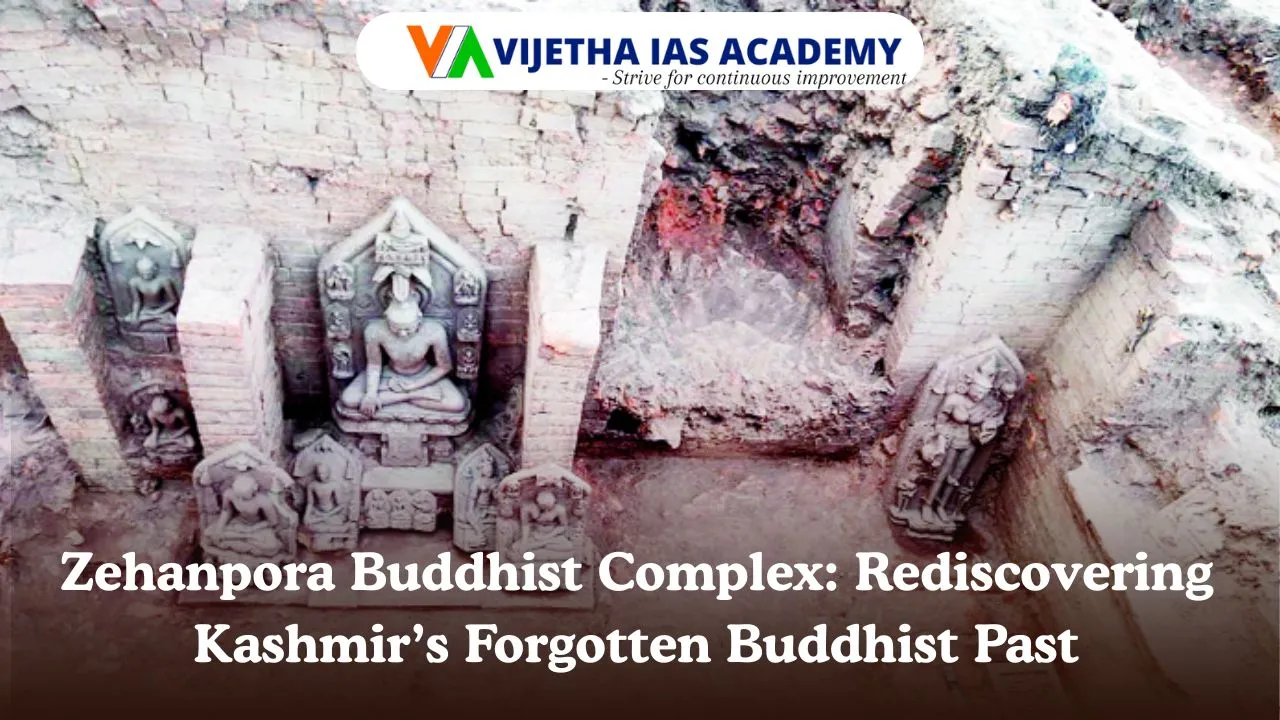
Zehanpora Buddhist Complex: Rediscovering Kashmir’s Forgotten Buddhist Past
Introduction
Kashmir has always been a meeting point of cultures, religions and trade routes. Yet, its early Buddhist history remained hidden for centuries. Small mounds in Zehanpora village, Baramulla were long ignored — until old photographs from a French museum helped scientists make one of the most important archaeological discoveries in modern Kashmir.
This case study is highly important for UPSC Anthropology Paper-I (Archaeological Anthropology)
How Old Photos Solved a 2,000-Year-Old Mystery
Three blurred photographs preserved in a French museum archive showed outlines of Buddhist stupas in Baramulla.
These images acted as historical evidence and led Indian archaeologists to re-investigate Zehanpora.
Even the Prime Minister mentioned this discovery in Mann Ki Baat.
Archaeological Investigation
Scientists used:
- Drone mapping
- Aerial photography
- Ground surveys
They found:
- Ancient Buddhist stupas
- Urban-type settlements
The site lies on an ancient Silk Route connecting Kashmir to Central Asia, showing its global importance.
What Did Excavations Reveal?
A major Buddhist centre
Multiple stupas prove that Zehanpora was a strong monastic and religious hub.
A well-planned settlement
Evidence of:
- Roads
- Housing
- Economic organisation
shows that this was not a small religious site but a thriving urban Buddhist town.
Kushan and Gandhara connection
Artifacts belong to the Kushan period (1st–3rd century CE) and match the Gandhara civilisation.
Why Zehanpora is Historically Important
The site proves that Kashmir was:
- A centre of Buddhist learning
- A key link in the Gandhara Buddhist network
- A transmission zone for ideas, monks and traders
Anthropological Meaning
This discovery supports theories of:
- Cultural diffusion through trade routes
- Monastic–lay social systems
- Ecological adaptation in Himalayan regions
It shows how religion, economy and environment shape human civilisation
Conclusion
The Zehanpora discovery has rewritten Kashmir’s ancient history. By combining modern technology and old archives, archaeologists revealed a 2,000-year-old Buddhist civilisation that connected India with Central Asia.
It is a powerful example of how archaeological anthropology brings the past back to life