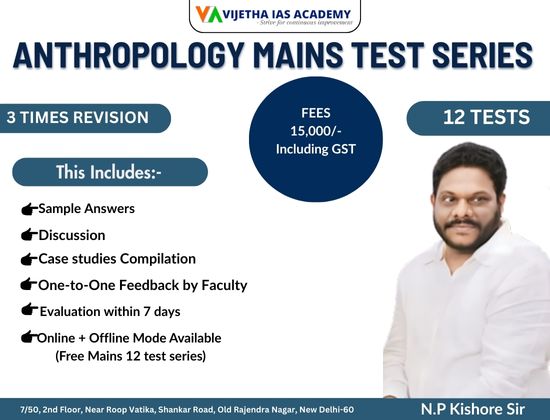
Anthropology Mains Test Series – 12 Tests
Anthropology Mains Test Series – 12 Tests
Complete Answer Writing and Revision Programme for UPSC Mains 2026 & 2027
Anthropology Optional is widely recognised as one of the most scoring optional subjects in the UPSC Civil Services Examination. Every year, several toppers and successful candidates score very high marks in Anthropology because of its limited syllabus, conceptual clarity, and predictable question trends.
However, scoring well in Anthropology Mains does not depend only on reading notes or completing the syllabus. The real improvement comes only when aspirants practise exam-oriented answer writing, understand model answers, use case studies effectively, and receive personalised feedback on their answers.
To meet this exact requirement, Vijetha IAS Academy has designed the Anthropology Mains Test Series – 12 Tests, a comprehensive programme that provides content support, structured revision, and expert evaluation, all aligned strictly with the UPSC Mains pattern.
Who Is This Test Series Meant For?
This test series is specially designed for aspirants who are appearing for UPSC Mains 2025 or 2026 and want focused, high-quality preparation for Anthropology Optional.
It is suitable for:
- First-time aspirants who want to develop strong answer writing skills
- Repeat aspirants who want to improve their previous Anthropology score
- Working professionals who need a structured and time-efficient programme
Regardless of whether you are a beginner or an experienced aspirant, this 12-test structure helps you improve both conceptual understanding and writing quality in a systematic manner.
Programme Highlights – Anthropology Mains Test Series (12 Tests)
1. Twelve High-Quality UPSC Mains-Level Tests
The test series consists of 12 well-designed tests that cover the entire Anthropology Optional syllabus in a planned and logical sequence.
- 6 Topic-wise Sectional Tests
- 6 Comprehensive Tests
The sectional tests help aspirants master individual topics, while the comprehensive tests combine multiple topics to simulate the actual UPSC Mains examination.
All questions are framed strictly according to:
- UPSC Mains demand
- Current question trends
- Required analytical depth
- Prescribed word limits
2. Sample Model Answers and Answer Discussions
After every test, aspirants receive sample model answers that clearly reflect the structure and content expected by UPSC examiners.
These model answers:
- Follow a proper introduction–body–conclusion format
- Show how to use keywords effectively
- Include diagrams wherever relevant
- Demonstrate value addition through examples and case studies
By studying these answers, aspirants clearly understand the difference between average answers and high-scoring answers.
3. Case Studies Compilation – A Key Scoring Component
Case studies are one of the most important tools for scoring well in Anthropology Mains, especially in Paper II. UPSC consistently rewards answers that combine theory with real-life tribal and social examples.
This test series provides:
- A compiled and updated collection of case studies
- Ready-to-use examples for both Paper I and Paper II
- Relevant tribal, developmental, and social case references
These case studies help aspirants enrich their answers, avoid repetition, and add practical relevance, which can significantly improve overall marks.
4. One-to-One Faculty Feedback and Evaluation
The biggest strength of this test series is its personalised evaluation system.
- Each answer is evaluated individually
- Detailed written feedback is provided within 7 days
- Feedback focuses on:
- Conceptual clarity
- Answer structure
- Use of diagrams
- Case study integration
- Value addition
- Time management
- Conceptual clarity
Instead of general comments, aspirants receive specific and actionable suggestions, which lead to steady improvement in every test.
5. Built-in Three-Time Revision Strategy
Revision is the key to scoring well in Anthropology Optional. This test series is designed in such a way that aspirants revise the entire syllabus at least three times.
- Sectional tests ensure the first level of revision
- Comprehensive tests provide integrated revision
- Full-length tests help in final consolidation
Each test pushes aspirants to revisit notes, refine understanding, and apply concepts in a better manner. This repeated revision leads to better retention, confidence, and writing quality.
6. Online and Offline Mode with Flexible Timings
The Anthropology Mains Test Series is available in both online and offline modes, making it accessible to aspirants across the country.
- Suitable for students in Delhi and outside Delhi
- Flexible writing and submission schedule
- Timely evaluation without unnecessary pressure
This flexibility makes the programme ideal for working professionals and college students.
Simplified Test Structure
Tests 1–6: Paper I (Conceptual Foundation)
The first six tests focus on the core and scoring areas of Anthropology Paper I, including:
- Human evolution
- Genetics
- Race and human variation
- Growth and development
- Archaeology
- Tools and technology
- Dating methods
- Forensic anthropology
These tests help build a strong theoretical base, improve diagram usage, and ensure clarity in fundamental concepts.
Tests 7–12: Paper II (High-Yield and Applied Areas)
Paper II plays a decisive role in achieving high scores. These tests cover:
- Kinship, marriage, and family
- Caste system and tribes
- Village studies
- Development anthropology
- Constitutional safeguards
- Tribal administration
- Social issues and ethnicity
The last 3–4 tests are full-length comprehensive tests, which closely simulate the actual UPSC Mains examination environment and help aspirants manage time and pressure effectively.
Why This 12-Test Mains Series Is Essential for Anthropology Aspirants
- Toppers-level model answers
- Ready-to-use case studies
- Complete syllabus coverage
- Personalised faculty feedback
- UPSC-pattern question setting
- Time management practice
- Answer structuring improvement
- Diagram-based enhancement
- Multiple revisions ensuring score improvement
This is not just a test series but a complete Mains preparation system for Anthropology Optional.
Final Note for UPSC 2026 & 2027 Aspirants
If you are preparing for Anthropology Optional and:
- Your marks are not improving despite preparation
- You lack confidence in answer writing
- You want examiner-oriented practice
- You are aiming for a 280–310+ score range
then the Anthropology Mains Test Series – 12 Tests by Vijetha IAS Academy can play a crucial role in your success.
UPSC Mains success depends on regular writing, expert feedback, and repeated revision, and this programme integrates all three in a structured manner.
Fee Details-₹15,000/- (Including GST)
At this fee, the combination of structured mentorship, detailed evaluation, content support, model answers, and case studies is rarely available elsewhere.