
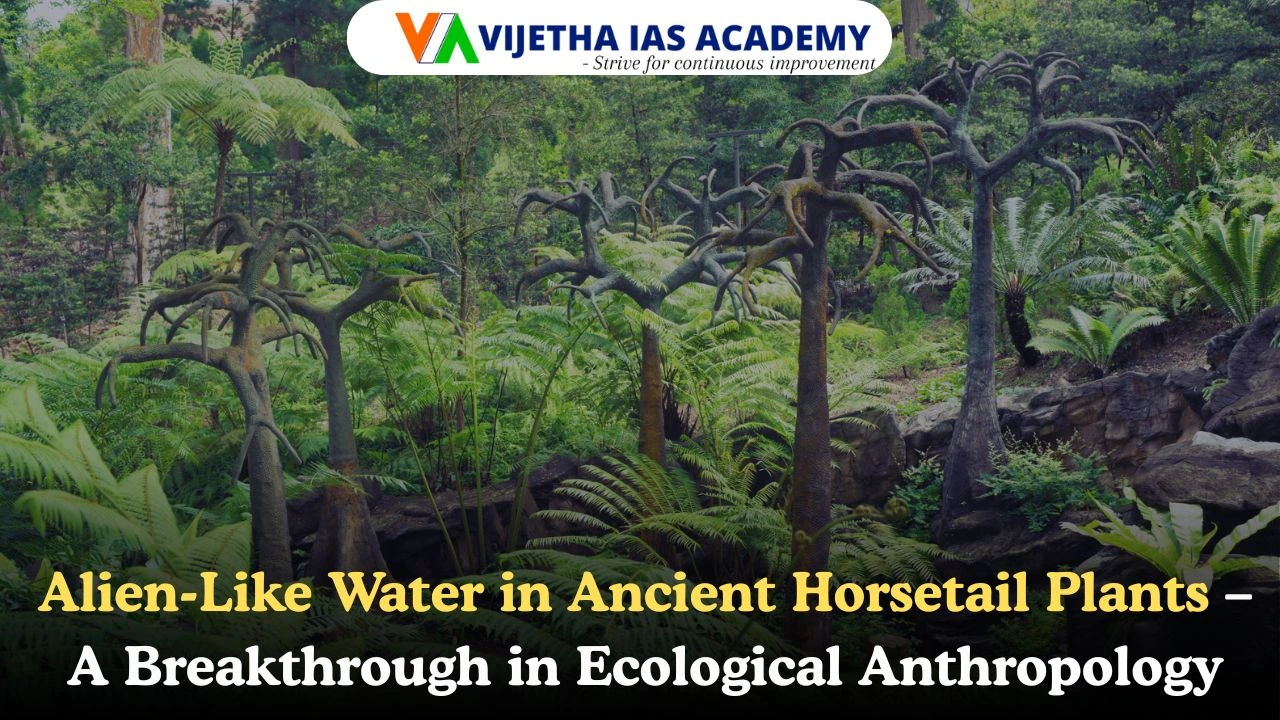
Alien-Like Water in Ancient Horsetail Plants – A Breakthrough in Ecological Anthropology
(Paper I – 9.7: Concepts and Methods of Ecological Anthropology)
Introduction
A recent study from the University of New Mexico has revealed a fascinating phenomenon in one of Earth’s oldest plant lineages — the horsetail (Equisetum). This plant, which has survived for more than 400 million years, is now helping scientists decode climate patterns through an unexpected discovery: “weird water” with isotope signatures that resemble meteorites.
What Exactly Was Discovered?
Researchers observed that as water passes through the horsetail plant’s hollow stem, it undergoes extreme isotope fractionation, particularly in oxygen isotopes.
- The isotope composition becomes so altered that it resembles extraterrestrial water signatures.
- No other plant on Earth has ever shown such unusual isotopic behavior.
This makes the plant function almost like a natural distillation tower, filtering and transforming water with extraordinary precision.
Why Is This Significant?
- A Natural Climate Recorder
- By tracking isotope changes from the plant’s base to its tip, scientists can infer humidity, environmental moisture, and water sources.
- This solves long-standing puzzles about isotope patterns in desert vegetation.
- By tracking isotope changes from the plant’s base to its tip, scientists can infer humidity, environmental moisture, and water sources.
- Unlocking Ancient Climate Data
- Fossilized horsetails — once growing up to 30 metres tall — contain phytoliths, tiny silica structures that preserve isotope signatures.
- These phytoliths act as paleo-hygrometers, enabling reconstruction of humidity from millions of years ago.
- Fossilized horsetails — once growing up to 30 metres tall — contain phytoliths, tiny silica structures that preserve isotope signatures.
- Engineering Marvel from Nature
- Lead researcher Prof. Zachary Sharp described the plant’s structure as “a meter-high cylinder with a million equally spaced holes,” making it an incredibly efficient natural filter — far beyond what labs can replicate.
- Lead researcher Prof. Zachary Sharp described the plant’s structure as “a meter-high cylinder with a million equally spaced holes,” making it an incredibly efficient natural filter — far beyond what labs can replicate.
Broader Scientific Impact
- Improved climate models through revised understanding of isotope fractionation in arid-zone plants.
- New tools for geoscientists to study paleo-environments.
- Better predictions of long-term climate change using plant-based data records.
- Interdisciplinary value combining ecology, botany, paleoclimatology and geochemistry.
Anthropological Analysis: Why This Matters
Ecological Anthropology examines how organisms interact with environmental systems. This case study shows:
- Plants serve as indicators of environmental change, influencing human adaptation studies.
- Reconstructed ancient climates help anthropologists understand the ecological pressures that shaped human evolution and cultural change.
- Primitive plants, often overlooked, may hold key data about long-term environmental patterns crucial for modelling future climatic stress and human resilience.
Conclusion
The horsetail plant, one of Earth’s oldest survivors, has emerged as a groundbreaking tool for climate reconstruction. This discovery highlights how ancient biological systems continue to inform modern environmental science — and ultimately, anthropological understanding of human–environment interactions.