
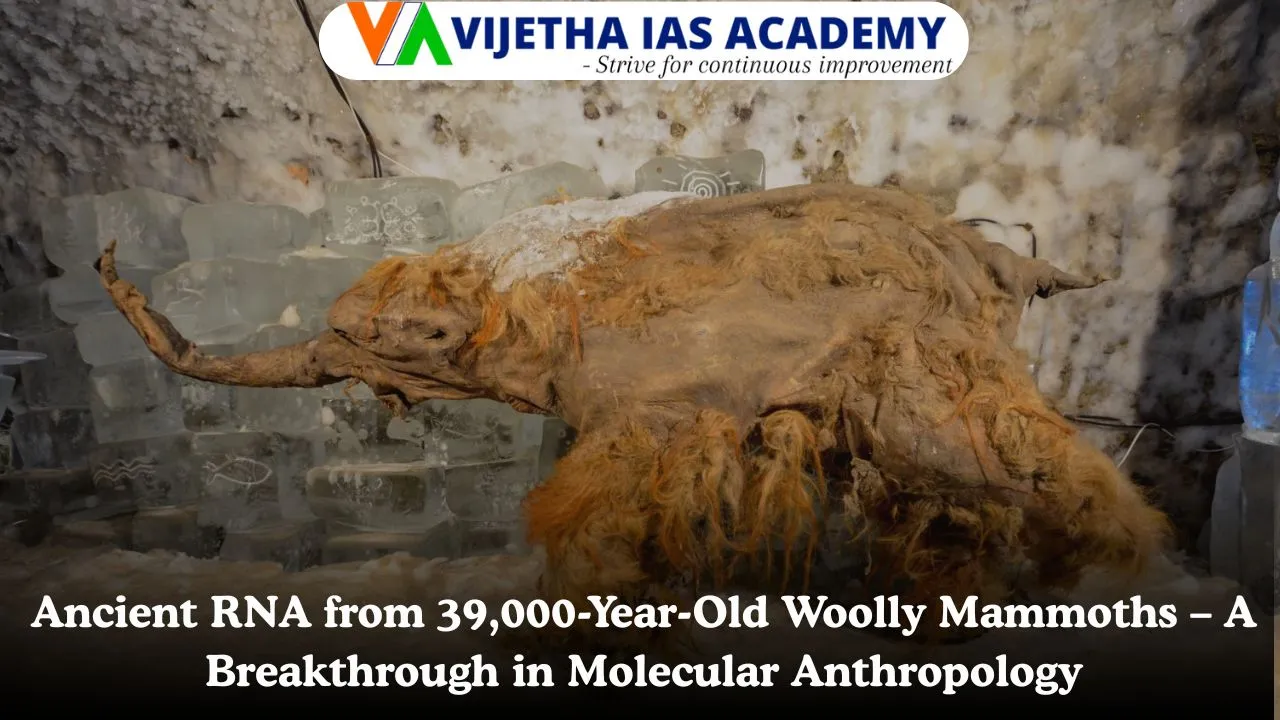
Ancient RNA from 39,000-Year-Old Woolly Mammoths – A Breakthrough in Molecular Anthropology
A groundbreaking scientific discovery in 2025 has changed how researchers understand ancient life. For the first time in history, scientists successfully extracted ancient RNA (aRNA) from 39,000-year-old woolly mammoths preserved in the Siberian permafrost. Earlier, researchers believed that RNA—being extremely fragile—cannot survive beyond a few years. But this study by Mármol-Sánchez and team has rewritten the rules of molecular anthropology.
Background: Why This Discovery Is Historic?
The specimen called Yuka, a juvenile mammoth, is now the oldest known source of preserved RNA ever recorded. Until now, ancient DNA and proteins were the primary tools for studying extinct species. The survival of RNA for tens of thousands of years was unimaginable. This gives anthropologists a new way to study ancient biology—not just what genes existed, but what genes were actually active at the time of death.
Where Was It Found?
The samples came from:
- Northeastern Siberia
- Indigirka region
- Oyogos Yar coast
- New Siberian Islands
These areas are covered by continuous permafrost, which acted like a natural deep freezer for thousands of years.
What Were Scientists Trying to Understand?
The study aimed to:
- Test whether RNA can survive for thousands of years
- Detect gene activity during the final hours of the mammoth's life
- Explore clues about cold adaptation, metabolic stress, and ancient diseases
- Identify tissue-specific functions and microRNAs
How Did They Do It?
The researchers used:
- Advanced RNA extraction methods
- High-throughput sequencing
- Comparative genomics with modern elephants
- microRNA profiling to confirm mammoth origin
Key Findings
1️⃣ RNA Survived 39,000 Years
The discovery showed that even fragile molecules like:
- mRNA
- microRNA
- Novel RNA transcripts
can survive under extreme cold conditions.
2️⃣ Real-Time Biological Activity at the Time of Death
Unlike DNA, RNA tells us which genes were active.
The study revealed genes related to:
- Muscle contraction
- Cold adaptation
- Stress response
3️⃣ Evidence of Gene Regulation
Muscle-specific microRNAs indicated active gene regulation in mammoths.
4️⃣ Discovery of Unknown Genes
Researchers identified new genes never recorded before, based solely on RNA.
5️⃣ Insights Into Ancient Diseases
Since many pathogens are RNA-based, this opens the door to studying:
- Prehistoric flu
- Ancient coronaviruses
- Extinct RNA viruses
This helps reconstruct ancient disease evolution.
Why This Matters for Anthropology?
This discovery:
- Extends molecular research beyond DNA
- Helps understand Ice Age adaptation
- Enables reconstruction of biological states just before death
- Opens possibilities for RNA recovery from Neanderthals, Denisovans, and early Homo sapiens
- Supports multi-omics approaches in archaeology
Conclusion
The survival of RNA for nearly 40,000 years is a scientific revolution. It allows anthropologists to study ancient physiology, gene regulation, and environmental adaptation with unmatched detail. This breakthrough shifts the direction of molecular anthropology and opens new possibilities for exploring human evolution.