
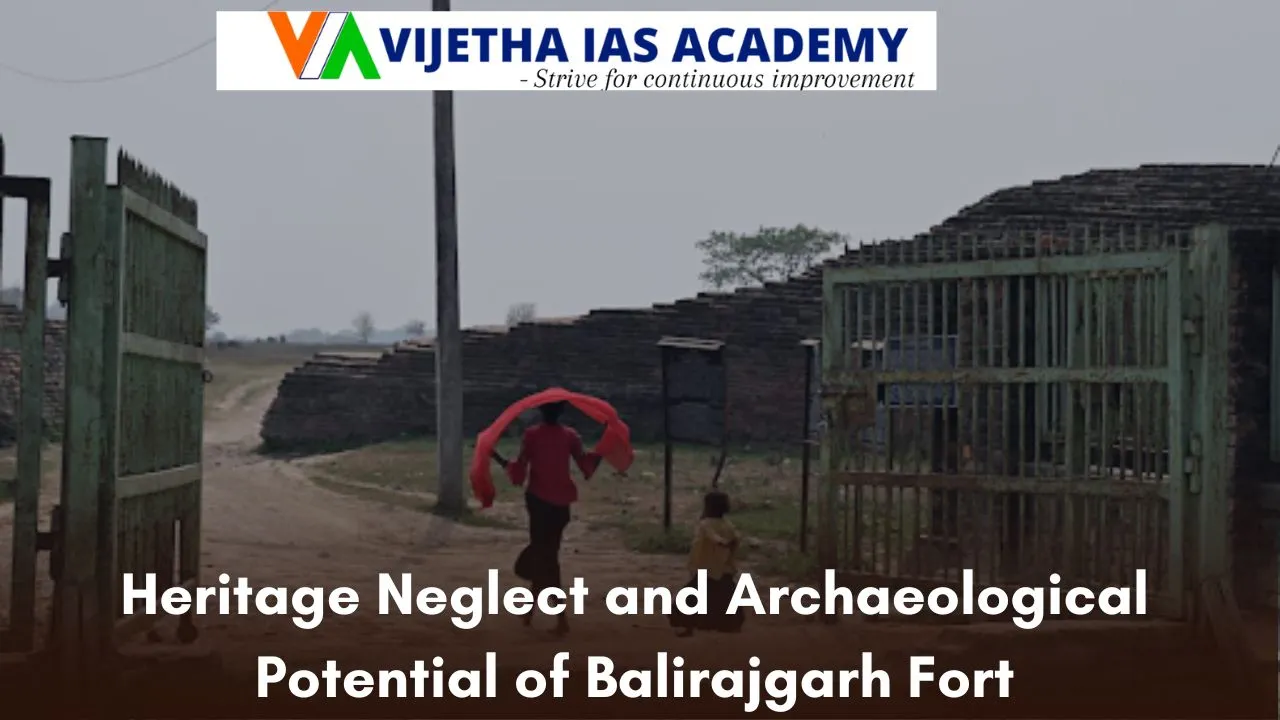
Heritage Neglect and Archaeological Potential of Balirajgarh Fort
Introduction
India has a rich archaeological heritage that reflects the continuity of civilisation from ancient to medieval times. However, many important sites remain neglected due to poor management and lack of coordination. One such example is Balirajgarh Fort in Bihar, which highlights key issues in Archaeological Anthropology like heritage conservation, governance challenges, and cultural continuity.
Background of Balirajgarh Fort
Balirajgarh Fort is located in the Madhubani District, around 35 km from Madhubani town. The site spreads across nearly 122 acres and is officially recognised as a centrally protected monument.
The fort was first identified in 1884 by George Abraham Grierson, making it an important site for historical and archaeological research.
Historical and Cultural Significance
Archaeological findings suggest that Balirajgarh was once a major urban centre in the Mithila region. Excavations reveal continuous habitation across multiple historical phases, including:
- Northern Black Polished Ware Culture (700–200 BCE)
- Sunga Dynasty
- Kushan Empire
- Gupta Empire
- Pala Empire
This long cultural sequence shows the evolution of early urban settlements in eastern India and provides insights into ancient socio-economic life.
Archaeological Excavations
Excavations at Balirajgarh have been carried out at different times:
- 1962–63 – Initial excavation
- 1972–73 – Bihar State Archaeology Directorate work
- 2013–14 – Excavation by Archaeological Survey of India (ASI), later halted
- 2026 – New excavation plan approved by ASI
Despite these efforts, large parts of the site remain unexplored.
Current Condition and Challenges
Even though the site is protected, it suffers from serious neglect:
- Animals like cattle and pigs roam freely
- Waste accumulation and poor hygiene
- Damaged boundary walls and weak security
- Old excavation pits filled with soil and weeds
- Over 20 mounds still unexplored
Local activities such as fairs also disturb the site, affecting preservation efforts.
Administrative Issues
The case reflects governance challenges:
- Conflict between central (ASI) and state authorities
- Delays due to lack of coordination
- Limited power of state government in centrally protected sites
This highlights the need for better policy implementation and cooperation.
Anthropological Significance
Balirajgarh Fort is important for understanding:
- Settlement patterns and urban evolution
- Material culture and pottery traditions
- Socio-economic organisation of early societies
It helps anthropologists reconstruct the lifestyle and cultural continuity of ancient populations.
Key Challenges in Heritage Conservation
- Lack of funding and manpower
- Environmental issues like waterlogging
- Encroachment and local interference
- Low public awareness
These challenges are common across many archaeological sites in India.
Way Forward
To protect and utilise the site effectively:
- Scientific and systematic excavation
- Strengthening site security
- Community awareness programmes
- Promotion of heritage tourism
- Better coordination between central and state governments
Conclusion
Balirajgarh Fort represents a classic case of high archaeological importance but poor management. With proper conservation, it can provide valuable insights into early urban civilisation in the Mithila region. Effective governance, scientific research, and public participation are essential to preserve such heritage sites for future generations.
Quick FAQs (For UPSC Revision)
Q1. Why is Balirajgarh Fort important in Anthropology?
It shows cultural continuity and early urbanisation in eastern India.
Q2. Which organisation manages the site?
The Archaeological Survey of India manages it.
Q3. What is the main issue highlighted in this case?
Heritage neglect and administrative challenges.