
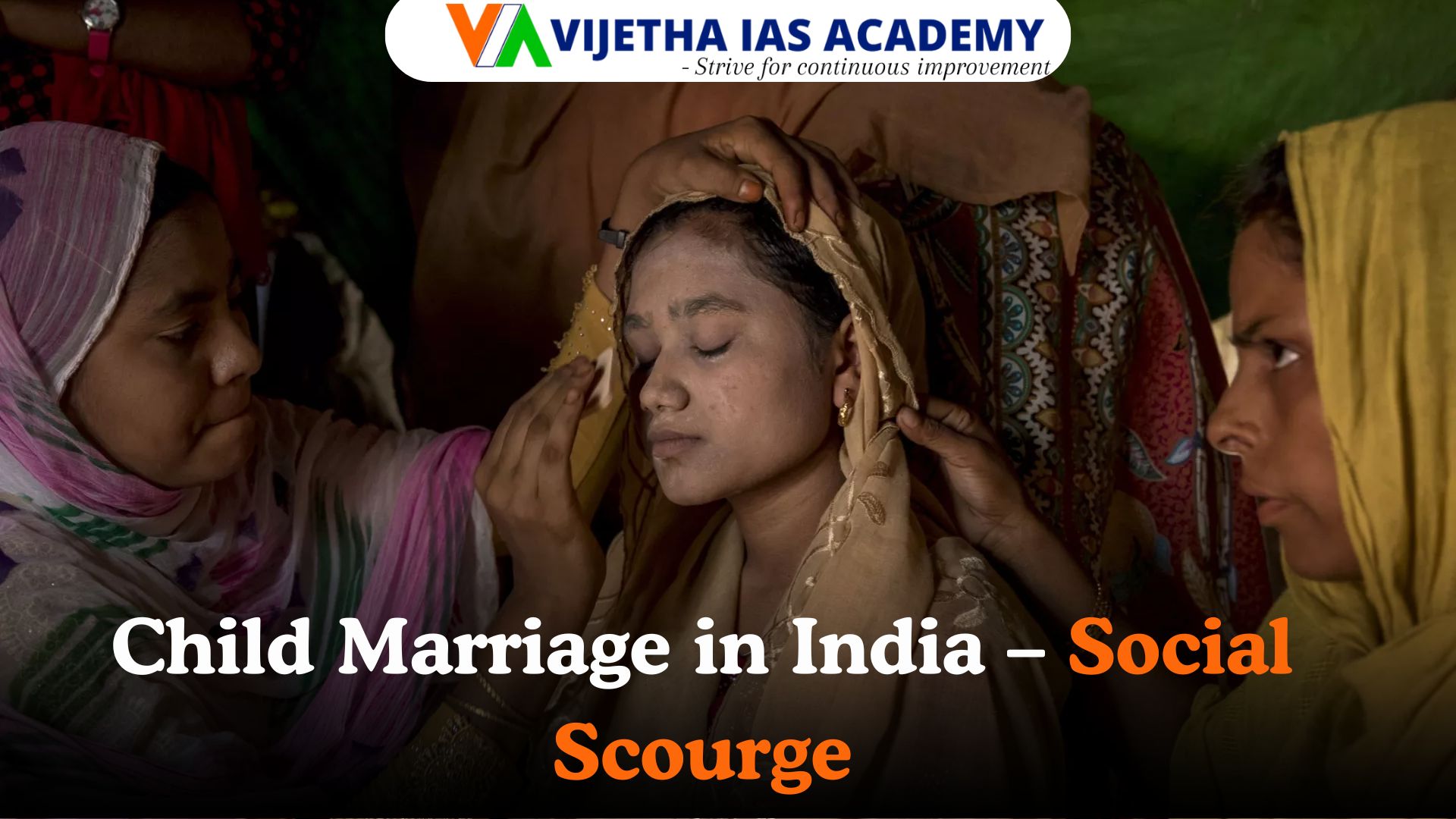
Child Marriage in India – Social Scourge
Introduction
Why does child marriage continue in India despite strong laws, awareness campaigns, and economic growth? Anthropology reveals that social practices are deeply rooted in culture, poverty, gender inequality, and tradition.
Child marriage remains one of India’s most persistent social problems, affecting health, education, and gender equality. This case study is highly relevant for Anthropology Paper I – Marriage and Family.
Context and National Commitment
- India has committed to ending child marriage by 2030 under SDG-5 (Gender Equality).
- The government marked one year of the Bal Vivah Mukt Bharat Abhiyan with a 100-day nationwide awareness campaign.
- Despite efforts, child marriage continues in many regions.
Trends and Progress
According to NFHS data:
- Child marriage declined from 47.4% (2005–06) to 23.3% (2019–21)
- Progress exists, but it is uneven across states and communities
Regional and Socio-Economic Disparities
High-prevalence states include:
- West Bengal
- Bihar
- Tripura
Other vulnerable states:
- Jharkhand, Andhra Pradesh, Assam, Telangana, Madhya Pradesh, Rajasthan
Key anthropological findings:
- 40% of girls from the poorest families married before 18
- 48% of girls with no education married early
- Only 4% among girls with higher education faced child marriage
This shows a strong link between poverty, education, and marriage practices.
Legal Framework and Its Limitations
- Prevention of Child Marriage Act (2006) aims to stop the practice, but enforcement remains weak.
- NCRB data shows low reporting and conviction rates.
- POCSO Act, though protective, sometimes criminalises consensual adolescent relationships.
As a result, many underage girls avoid healthcare and legal systems.
Health, Education, and Gender Impact
Child marriage leads to:
- Early pregnancy and maternal health risks
- School dropouts
- Malnutrition
- Intergenerational poverty
- Gender inequality
This makes child marriage not just a legal issue, but a developmental and cultural problem.
Anthropological Perspective
Anthropology explains child marriage through:
- Social norms and tradition
- Patriarchal family structures
- Economic insecurity
- Control over female sexuality
Financial incentives alone cannot change deeply rooted social behaviour.
Way Forward
Ending child marriage requires:
- Strong law enforcement with community participation
- Secondary education for girls
- Economic empowerment of families
- Context-sensitive legal reforms
- Behavioural and social change at the community level
Conclusion
Despite measurable progress, child marriage remains a complex socio-cultural issue in India. Without addressing poverty, education, and gender norms together, legal measures alone will fail. A Bal Vivah Mukt Bharat is not only a legal goal but a moral and developmental necessity.