
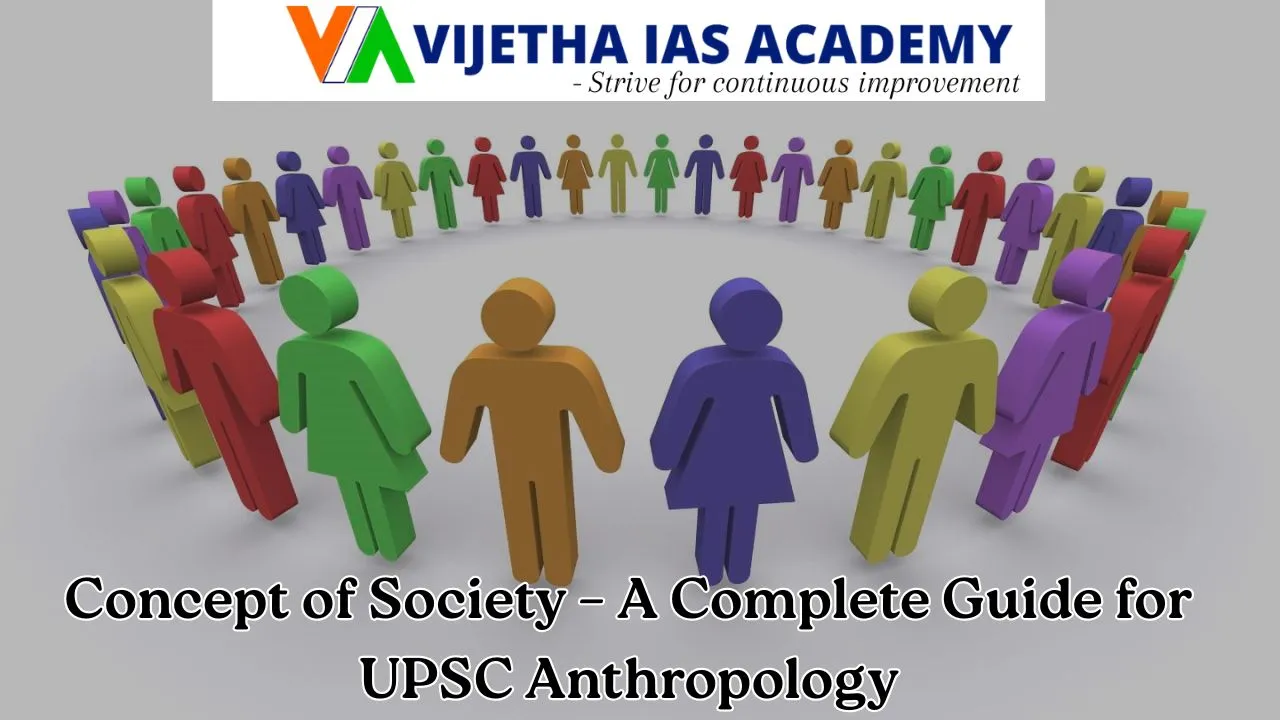
Concept of Society – A Complete Guide for UPSC Anthropology
Understanding the concept of society is crucial in sociology and anthropology, especially for UPSC aspirants with Anthropology Optional. Society is not just a collection of individuals but a complex web of relationships, norms, and interactions that bind people together.
Meaning of Society
In anthropology and sociology, society refers to the structured patterns of interaction, cooperation, and interdependence among individuals.
- According to Giddings: Society is several like-minded individuals who know and enjoy their like-mindedness and work together for common ends.
- According to G.D.H. Cole: Society is the complex of organized associations and institutions within the community.
Thus, society is intangible but functions through human interaction, cooperation, and shared goals.
Characteristics of Society
- A web of relationships – Social ties create interdependence.
- Likeness and differences – Members share similarities but also differences.
- Interdependence – Individuals rely on each other for survival.
- Cooperation – Essential for social existence.
- Dynamic nature – Society constantly evolves with culture and needs.
Example: India is a classic example, where diversity coexists with unity.
Nature of Society
The connection between man and society has been debated since Aristotle’s statement: “Man is a social animal by nature, and one who does not live in society is either a beast or a God.”
Reasons why man is social:
- Humans are social by nature.
- Necessity pushes people to live collectively.
- Society shapes individual personality.
Social Groups
Social groups form the foundation of society.
- Definition (Honigmann): Whenever two or more individuals come together and influence each other in terms of common interest, they constitute a social group.
- Groups are classified as:
- Communities: Based on locality and belongingness (e.g., nomadic bands, agricultural communities).
- Associations: Organized for specific interests (political, economic, religious, kinship-based).
- Communities: Based on locality and belongingness (e.g., nomadic bands, agricultural communities).
Classification of Societies
- Based on Nature
- Simple societies (bands, villages)
- Complex societies (modern states, cities)
- Simple societies (bands, villages)
- Based on Subsistence Technology
- Hunting & Gathering (PVTGs in India)
- Horticultural (Gonds, Santhals)
- Pastoral (Todas, Tibetans)
- Agricultural (rural societies in Asia, Africa, Europe)
- Pre-Industrial & Industrialized societies
- Hunting & Gathering (PVTGs in India)
- Based on Solidarity (Durkheim)
- Mechanical solidarity (primitive, homogeneity)
- Organic solidarity (modern, interdependence)
- Mechanical solidarity (primitive, homogeneity)
- Based on Stratification
- Egalitarian (bands, tribes)
- Stratified (caste, class, rank, religion)
- Egalitarian (bands, tribes)
Society and Culture
Society and culture are deeply interlinked:
- Society: Web of relationships, institutions, and cooperation.
- Culture: Shared values, norms, and traditions that give meaning to social life.
Malinowski (Functionalist): Institutions emerge to fulfill individual needs.
Radcliffe-Brown (Structural Functionalist): Social structures exist to maintain social order.
Both culture and society are interdependent, ensuring social harmony and continuity.
Types of Societies
1. Simple Societies
- Small, primitive, pre-literate, and isolated.
- Eg: Chenchus of Andhra Pradesh (PVTG).
2. Complex Societies
- Large, literate, technologically advanced.
- Eg: Agricultural and Industrial societies.
3. Hunting & Gathering Societies
- Nomadic, egalitarian, kinship-based.
- Eg: PVTGs in India.
4. Horticultural Societies
- Cultivation using hoes and digging sticks.
- Surplus redistributed, ranked societies.
- Eg: Gonds and Santhals.
5. Pastoral Societies
- Domestication of animals, semi-nomadic.
- Eg: Todas (buffalo), Tibetans (yak), Bedouins (camel).
6. Agricultural Societies
- Sedentary, plough-based cultivation, permanent villages.
7. Pre-Industrial Societies
- Reliance on windmills, handicrafts, primary group ties.
8. Industrial Societies
- Machine production, factories, bureaucracy, rapid change.
Band and Tribe
- Band: Small, nomadic groups (20–50), kinship-based, egalitarian, no permanent leadership.
- Tribe: Larger, semi-nomadic/sedentary, with territorial identity, common language, and customs.
Key Difference:
- Bands are loosely knit and primitive.
- Tribes are more complex with clans, lineages, and political structures.
Conclusion
The concept of society explains how human beings are interconnected through culture, cooperation, and institutions. From simple bands to complex industrial societies, the study of society helps us understand the evolution of human social life—making it one of the most fundamental concepts in Anthropology Optional for UPSC.
Want to master Anthropology Optional for UPSC with expert guidance?
Join Vijetha IAS Academy – Delhi’s Trusted UPSC Hub for Classroom & Online Anthropology Coaching and Anthropology optional Test Series Programs.
Small Batches | Personal Mentorship | Proven Results
Enroll Now & Boost Your UPSC Mains Preparation!