
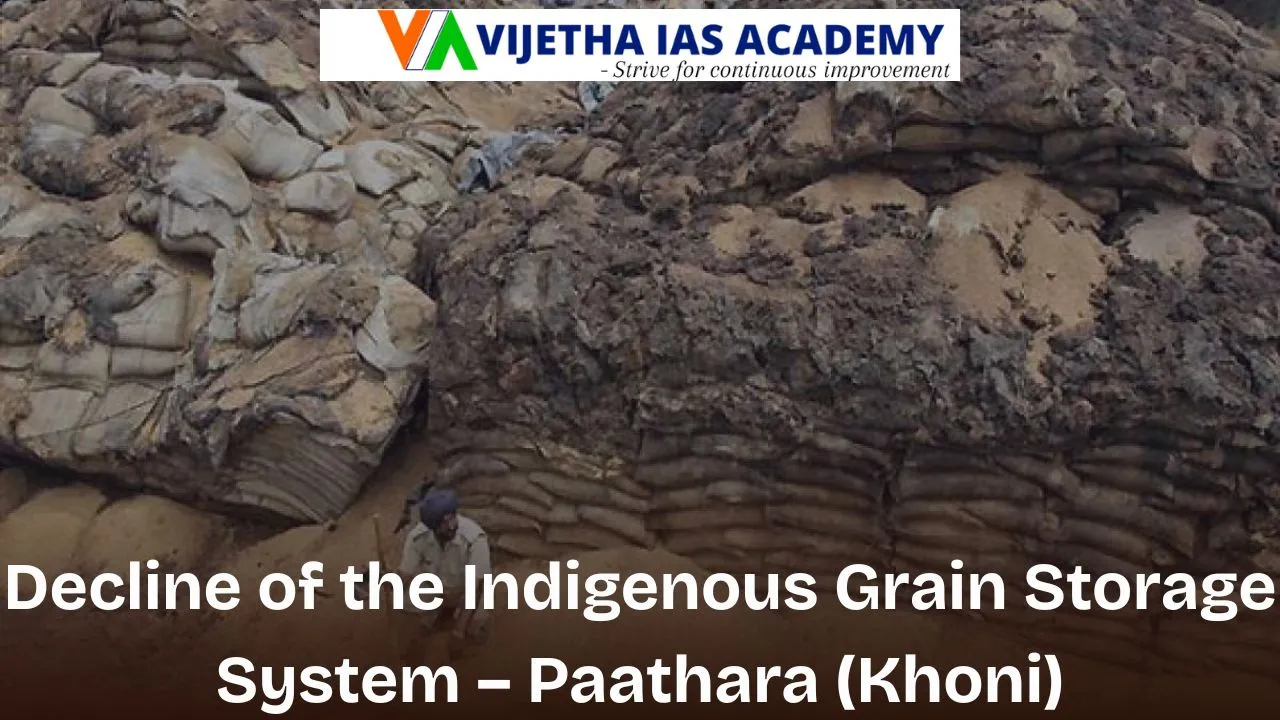
Decline of the Indigenous Grain Storage System – Paathara (Khoni)
Introduction
Across rural India, indigenous technologies once ensured food security, sustainability, and cultural continuity. One such remarkable system is Paathara (known as Khoni in Odia), a traditional underground grain storage practice found in the Uddanam region of Srikakulam district, Andhra Pradesh. Deeply rooted in agrarian life and rural architecture, Paathara symbolised a harmonious relationship between ecology, economy, and culture. However, by 2026, this indigenous system stands on the verge of extinction, reflecting the broader tension between modernisation and traditional wisdom.
Understanding the Paathara System
Paathara was an eco-friendly, household-level storage technology used mainly for paddy. Rectangular pits were dug underground in dry inland terrains, lined with straw ropes and clay for insulation, and sealed with cow dung to prevent moisture, pests, and contamination. Located in front of houses, Paatharas were integral to everyday domestic life.
The size of the pit indicated family size, landholding, and social status. Paddy stored in Paathara could last for nearly six months, ensuring food availability until the next monsoon and reducing dependence on markets.
Case Illustration: Jalantara Saasanam Village
Jalantara Saasanam, a village with nearly 200 households, presents a stark picture of decline. While earlier every household had a Paathara, only two were constructed in 2026.
One such example is Marla Dillemma (52), who stored around 30 bags of paddy for household consumption and performed ritual offerings before sealing the pit. Her practice represents the last surviving generation of Paathara users.
Factors Behind the Decline
The disappearance of Paathara is not accidental but the result of multiple interconnected changes:
- Structural and Spatial Changes: Replacement of thatched houses with concrete buildings, cement roads, and shrinking homestead spaces have made Paatharas incompatible with modern housing layouts.
- Agrarian and Economic Shifts: Decline in paddy cultivation due to inadequate Rabi irrigation, despite canal projects, and increasing market-dependent agriculture.
- Intergenerational Knowledge Gap: Migration of youth to cities has disrupted the transmission of traditional skills such as pit construction and sealing techniques.
- Institutional Neglect: Policy focus remains on modern silos and warehouses, ignoring culturally embedded indigenous storage systems.
Cultural, Nutritional, and Environmental Significance
Paathara ensured minimal post-harvest losses, protected grain from rodents and theft, and allowed farmers to wait for favourable market prices. Rice stored in Paathara was believed to have enhanced flavour and better digestibility due to mild natural fermentation.
Culturally, Paathara-stored rice was used in weddings, festivals, and rituals, symbolising continuity between land, ancestors, and community. Women played a central role in storage rituals and preservation of food knowledge, highlighting a strong gender dimension.
Governance Concerns and the Way Forward
The loss of Paathara signifies erosion of intangible cultural heritage and community-based food security. Reviving such systems requires:
- Ethnographic documentation and heritage recognition
- Integration with sustainable agriculture policies
- Innovative housing designs accommodating Paathara
- Intergenerational knowledge transfer through schools and local museums
Conclusion
The decline of Paathara is not merely the disappearance of a storage pit but the loss of a holistic agrarian worldview where ecology, culture, nutrition, and faith coexisted. Preserving such indigenous systems is crucial for sustainable and culturally sensitive development.