
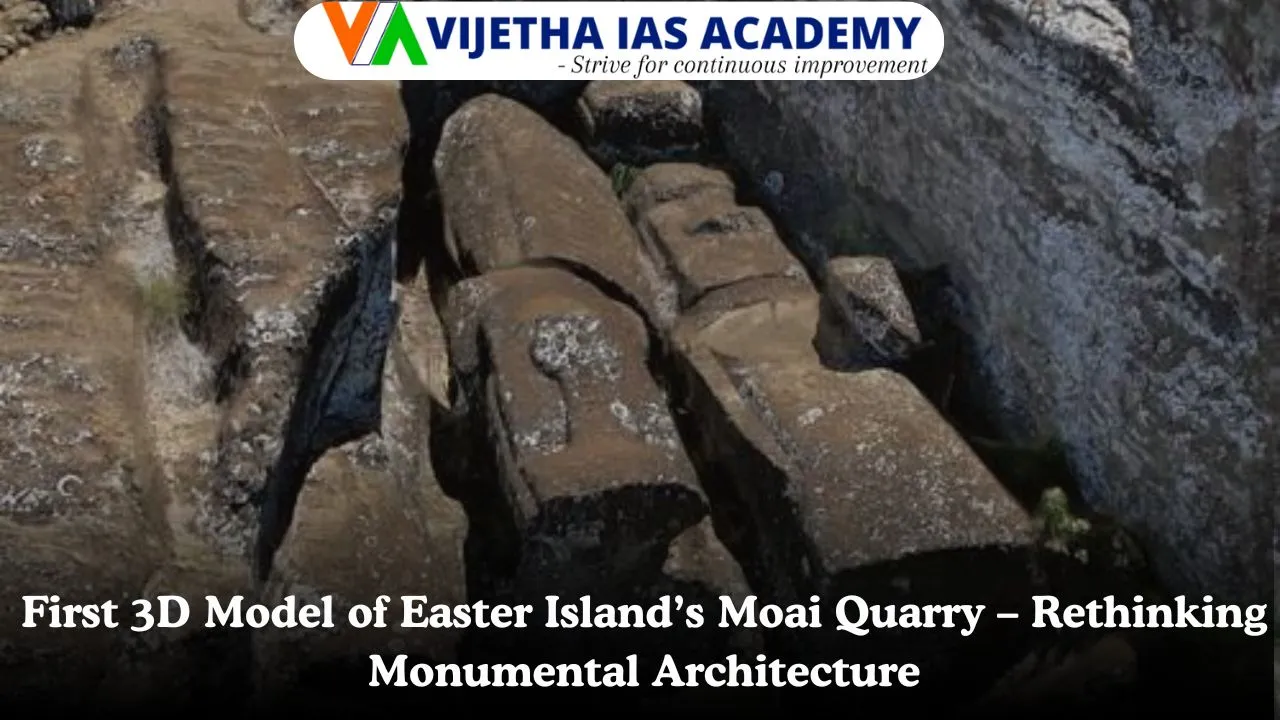
First 3D Model of Easter Island’s Moai Quarry – Rethinking Monumental Architecture
Easter Island (Rapa Nui) is home to over 1,000 majestic moai statues. These stone giants have fascinated archaeologists for decades. One big mystery always remained:
How did a small, decentralized island society construct such massive monuments without a central authority?
A new scientific study has finally provided answers through the first-ever high-resolution 3D model of the island’s primary quarry, Rano Raraku.
Context: The Puzzle of Moai Construction
Historically, scholars believed that building such large statues required:
- Strong leadership
- Centralized manpower
- Hierarchical chiefdoms
But Rapa Nui society was actually decentralized, composed of several kin-based groups (mata). So how did they coordinate such large-scale construction?
The breakthrough came when researchers created a complete digital reconstruction of the quarry using 11,000+ drone images.
How Was the 3D Model Created?
The model, developed by Carl Lipo and his team at Binghamton University, used:
- High-resolution drone (UAV) photography
- Photogrammetry techniques
- Advanced 3D landscape mapping
This technology made it possible to digitally visualize:
- The entire quarry
- Moai at different carving stages
- Pathways used to transport the statues
Major Discoveries
1️⃣ Decentralized Production Confirmed
The analysis identified:
- 30 distinct carving zones
Each zone had:
- Different crafting styles
- Separate working sequences
- Independent artisan groups
This shows multiple clans worked simultaneously—not under a single authority.
2️⃣ Multiple Transport Pathways
Statues were moved out of the crater in different directions, proving:
- There was no centralized distribution route
- Each clan transported its own statues
3️⃣ Clan-Based Workshops
The location and style of workshops matched the territorial boundaries of different mata (clans). This confirms moai construction was a community-driven process.
4️⃣ Cultural Unity Without Central Control
Even though carving was decentralized:
- Moai shared strong stylistic similarities
This suggests:
- Shared ritual beliefs
- Exchange of knowledge
- Cultural standardization through cooperation
5️⃣ A Challenge to Old Theories
Earlier theories assumed monument-building required:
- State-level organization
- Strong command structures
This study proves the opposite. Small-scale societies can build monumental structures through cooperation and shared cultural identity.
Anthropological Significance
This new evidence helps re-evaluate:
- Social complexity in small societies
- Organisation of labour in Polynesia
- How cultural identity shapes large-scale projects
It also connects with global traditions of decentralized monument building, such as:
- African megaliths
- European Neolithic structures
- Indian tribal megalithic systems
Impact on Archaeological Methods
The study highlights the value of:
- Drone-based mapping
- 3D digital reconstruction
- Open-access archaeological databases
These methods protect cultural heritage and make research more inclusive.
Conclusion
The 3D modelling of the Rano Raraku quarry has transformed our understanding of Easter Island. It proves that monumental architecture can emerge from decentralized, clan-based societies. This challenges long-standing assumptions and shows how technology can reshape interpretations of ancient cultures.