
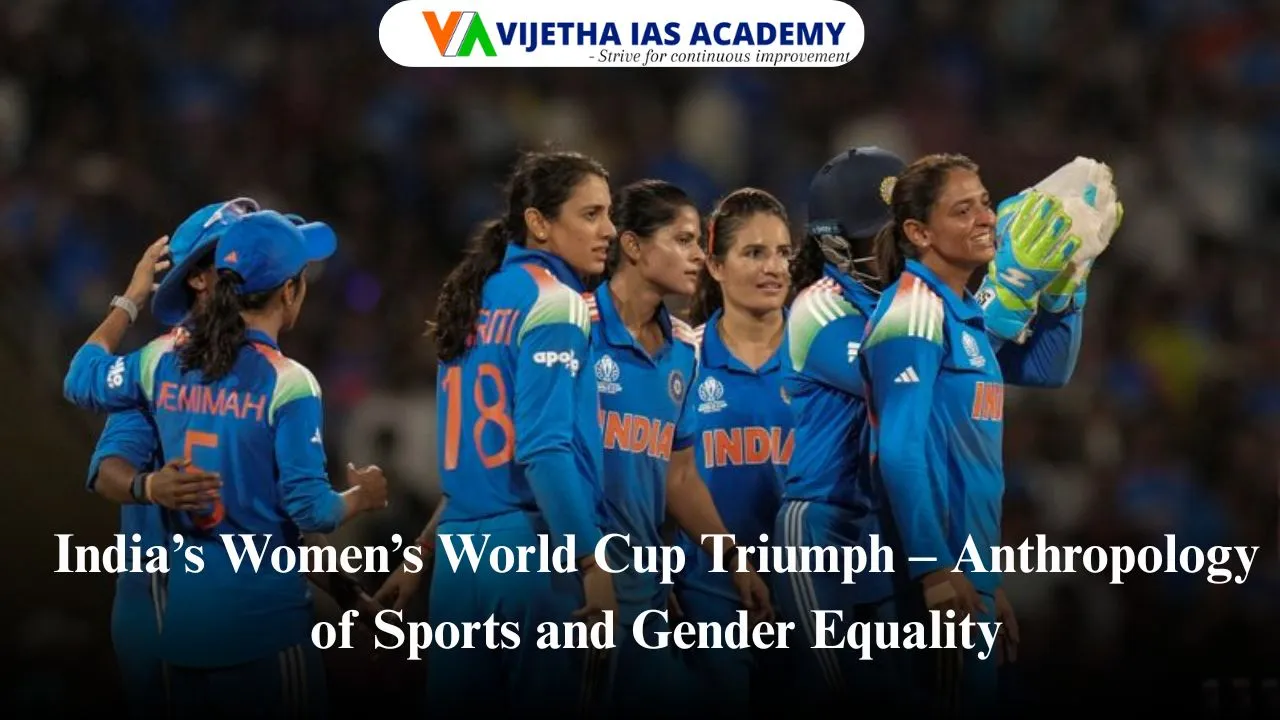
India’s Women’s World Cup Triumph – A Watershed Moment for Gender Equality and Sports Anthropology
Introduction
India’s victory in the 2025 Women’s Cricket World Cup was more than a sporting triumph — it was a social revolution in motion. When the Indian women’s team defeated South Africa by 52 runs at the D.Y. Patil Stadium in Navi Mumbai, it marked a defining moment in the nation’s cultural and gender landscape. This victory symbolised resilience, representation, and recognition — ideals deeply rooted in the Anthropology of Sports.
Background: From Setbacks to Success
The Indian team’s journey was anything but smooth. After losing three consecutive league matches against Australia, England, and South Africa, the odds looked stacked against them. Yet, under the determined leadership of Harmanpreet Kaur, the team rallied with grit and composure. The semi-final victory over seven-time champions Australia, chasing a record 330+ target, became the turning point.
In the final, Shafali Verma’s brilliant 87 and all-round performance, along with Deepti Sharma’s five-wicket haul (5/39), sealed India’s maiden title. The event instantly drew parallels with India’s 1983 men’s World Cup win — not just for cricketing glory but for the social awakening it inspired.
Anthropology of Sports: A Lens on Culture and Society
Sports anthropology studies how games reflect societal structures, values, and transformations. The women’s cricket victory in India provides a case study in how cultural change is reflected through athletic success. It embodies:
- Gender empowerment through visibility: Women athletes gaining national attention challenges long-held gender norms.
- Cultural transformation: Media and public narratives have shifted from viewing women’s sport as “secondary” to recognising it as a mainstream achievement.
- Collective identity: The win created a shared moment of pride that transcended gender, class, and region, uniting people through symbolic success.
This intersection of sport, gender, and culture illustrates how anthropology helps us interpret social progress.
Key Success Factors
- Resilience under adversity: The team turned early losses into lessons, showcasing psychological strength and teamwork.
- Inclusive team contribution: Beyond stars, every player and support staff member played a vital role, showing collective success over individual dominance.
- Leadership and tactical intelligence: Harmanpreet Kaur’s calm, strategic leadership under pressure was central to the victory.
- Cultural and media support: Growing visibility of women’s sport in India gave the players social validation and fan following.
- Public investment and institutional backing: The BCCI’s ₹51 crore reward reflected the growing seriousness of gender equity in sports policy.
Wider Implications and Cultural Significance
- Gender Equity and Empowerment: The triumph became a “Her-storical” moment, rewriting India’s sports narrative and inspiring young girls nationwide.
- Changing Market Dynamics: Brands and media started endorsing women athletes, opening up financial and professional opportunities that were earlier rare.
- Social Inclusion: Girls from small towns and rural areas now see sport as a viable career path, challenging patriarchal barriers.
- Policy Impact: The win may influence government initiatives toward better facilities, scholarships, and equal pay structures for women athletes.
Lessons and Takeaways
- Build holistic ecosystems: Success stems from continuous investment in coaching, mental health, nutrition, and infrastructure.
- Role of public narratives: Celebrating role models like Harmanpreet Kaur, Shafali Verma, and Deepti Sharma normalises women’s excellence in sports.
- Sustainability over celebration: Structural support must continue beyond victory — in leagues, scouting, and rural outreach.
- Gender mainstreaming: Sports governance must treat women’s participation as integral, not symbolic.
Conclusion
India’s Women’s World Cup triumph is not just a cricketing milestone — it is an anthropological event that reshapes gender identity, national pride, and the meaning of equality in sport. The challenge ahead lies in converting this celebration into sustained change, where every girl in India feels empowered to pick up a bat, a ball, or any dream — and believe she can win the world.