
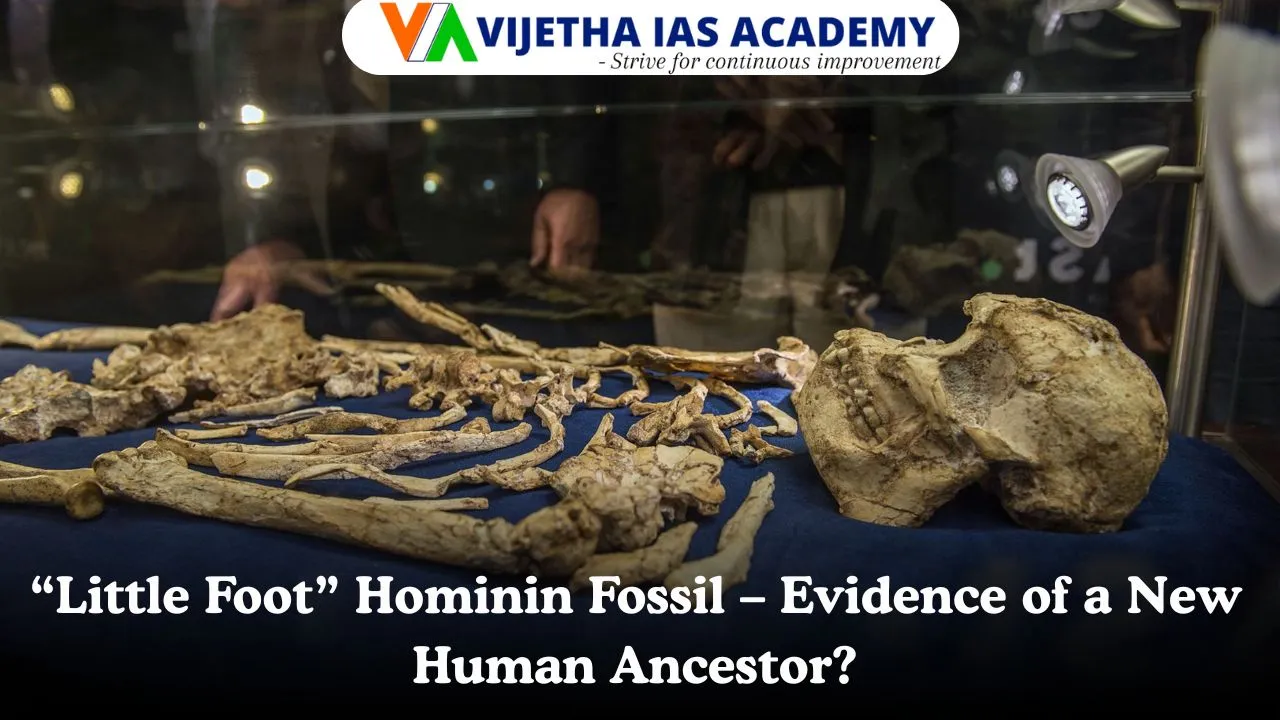
“Little Foot” Hominin Fossil – Evidence of a New Human Ancestor?
Introduction
Human evolution is not a straight line but a complex and branching process. One of the most fascinating discoveries supporting this idea is the “Little Foot” hominin fossil, found in South Africa. Recent scientific studies suggest that Little Foot may represent a previously unknown species of human ancestor, challenging long-held assumptions in paleoanthropology.
Background of the Discovery
- “Little Foot” is one of the most complete hominin skeletons ever discovered.
- It belongs to the genus Australopithecus.
- Found in the Sterkfontein cave system, South Africa—one of the most important sites for human evolution studies.
- Foot bones were first discovered in 1994, and excavation took over 20 years.
- The skeleton was publicly unveiled in 2017.
Importance of Australopithecus
Australopithecus (“southern ape”) lived in Africa around 4.2 million years ago and is crucial for understanding:
- The transition from arboreal to terrestrial life
- Early bipedalism
- Brain and cranial evolution before the emergence of the genus Homo
Debate on Species Classification
Scientists have long debated the species identity of Little Foot:
Australopithecus africanus
- First described in 1925
- Fossils already known from Sterkfontein
- Many researchers believed Little Foot belonged to this species
Australopithecus prometheus
- Proposed by Prof. Ronald Clarke, the excavation leader
- He argued that two distinct hominin species existed at Sterkfontein
New Australian Study: Key Findings
A recent study published in the American Journal of Biological Anthropology, led by Dr Jesse Martin, challenges both classifications.
Core conclusion:
Little Foot does not match the traits of either A. africanus or A. prometheus, suggesting it may belong to a previously unknown species.
Anatomical Evidence for a New Species
Researchers identified unique anatomical features, especially in the cranial base:
- A notably longer nuchal plane (back of the skull)
The cranial base is evolutionarily conservative, meaning it changes very slowly over time. Therefore:
- Differences here strongly indicate species-level divergence
- These variations are unlikely to be individual differences
Evolutionary Significance
The findings suggest:
- Human evolution was more complex and branching than earlier believed
- Sterkfontein may contain evidence of multiple coexisting hominin lineages
Dr Martin described this discovery as not just a missing “link” but possibly an entire “limb” of the human family tree, supporting the bushy model of evolution.
Dating Controversy
There is disagreement regarding the age of Little Foot:
- One estimate: 3.67 million years old
- Other scientists argue it is younger than 2.8 million years
Accurate dating is crucial as it affects:
- Evolutionary placement
- Relationships with other australopithecines
- Timing of key adaptations like bipedalism
Scientific Ethics and Taxonomic Caution
Although evidence supports a new species, the researchers:
- Did not formally name it
- Suggested that the original excavation team should have the authority
This reflects ethical practices in paleoanthropology.
Conclusion
The Little Foot fossil highlights the dynamic and evolving nature of scientific knowledge. Despite being one of the most complete hominin fossils ever found, it continues to reshape our understanding of early human diversity. The discovery reinforces that human evolution was non-linear, regionally complex, and richly diverse.