
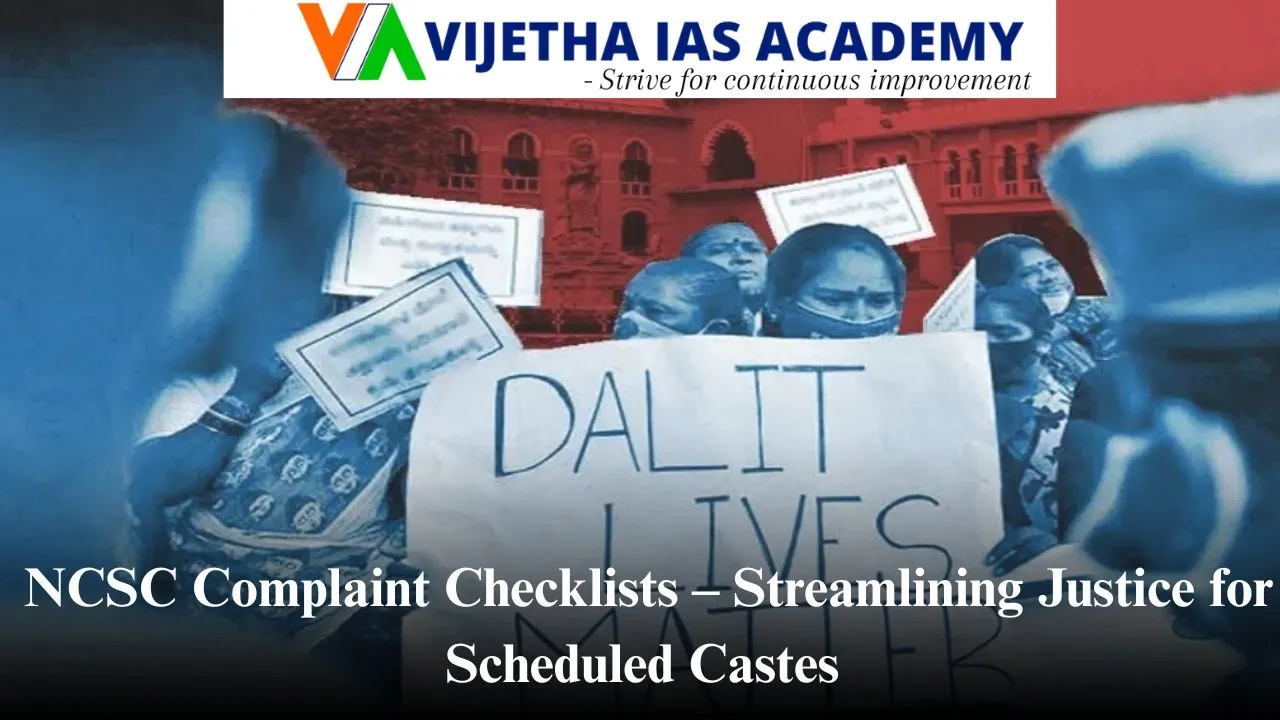
NCSC’s Complaint Checklists – A Step Toward Efficient SC Grievance Redressal
Background
The National Commission for Scheduled Castes (NCSC), formed under Article 338 of the Indian Constitution, safeguards the rights of Scheduled Castes (SCs). However, in recent years, it has faced a major issue—a high number of pending and irrelevant complaints, including some from non-SC individuals.
To solve this, the NCSC introduced standardised “checklists” to ensure that only genuine SC-related complaints are accepted and processed efficiently.
Key Developments
The Commission has issued detailed checklists for its three main departments:
- Service Safeguard Wing (SSW)
- Economic and Social Development Wing
- Atrocities and Protection of Civil Rights Wing
These checklists outline criteria for accepting, rejecting, or closing cases to ensure that the NCSC focuses on caste-based issues only.
Grounds for Rejection
Complaints can now be rejected if they:
- Are unsigned or anonymous.
- Lack a self-declaration of SC status.
- Are already pending in court.
- Concern policy issues beyond the NCSC’s scope.
When Complaints May Be Closed
A case may be closed without hearing if:
- Contact details are missing.
- The complainant withdraws or is satisfied.
- The issue isn’t directly linked to SC identity.
This ensures that only authentic caste-related cases receive attention.
Focus on Caste-Specific Issues
The NCSC has clarified that general administrative or corruption complaints will not be entertained unless they clearly involve caste discrimination.
For example, a job dismissal will only be considered if caste bias can be proven.
Procedural Clarity
Complainants must:
- Provide details of violated government rules or orders.
- Show proof of communication with concerned authorities before approaching NCSC.
The move promotes transparency and accountability while ensuring that real victims are heard.
Rationale and Impact
The checklist approach helps in:
- Reducing pendency by filtering non-relevant cases.
- Preventing misuse of the complaint system.
- Improving efficiency and focus on genuine caste grievances.
However, experts also warn of possible risks, such as bureaucratic gatekeeping or increased burden on marginalized complainants to prove caste-based discrimination.
Conclusion
The NCSC’s reform reflects a broader move towards institutional efficiency and accountability. But it must also balance administrative order with social justice, ensuring that procedural clarity does not silence genuine voices.
Call to Action
Understanding institutions like the NCSC is a vital part of Anthropology Paper II in UPSC. At Vijetha IAS Academy, Delhi, students learn how administrative systems interact with caste, culture, and social justice through daily case studies and mentorship programs.
Join Vijetha IAS Academy’s Anthropology Optional Course today and strengthen your UPSC preparation with expert guidance, structured notes, and real-world case study analysis.
Join Anthropology Optional Courses & Anthropology optional Test Series – Your Path to 300+ Marks Starts Here.