
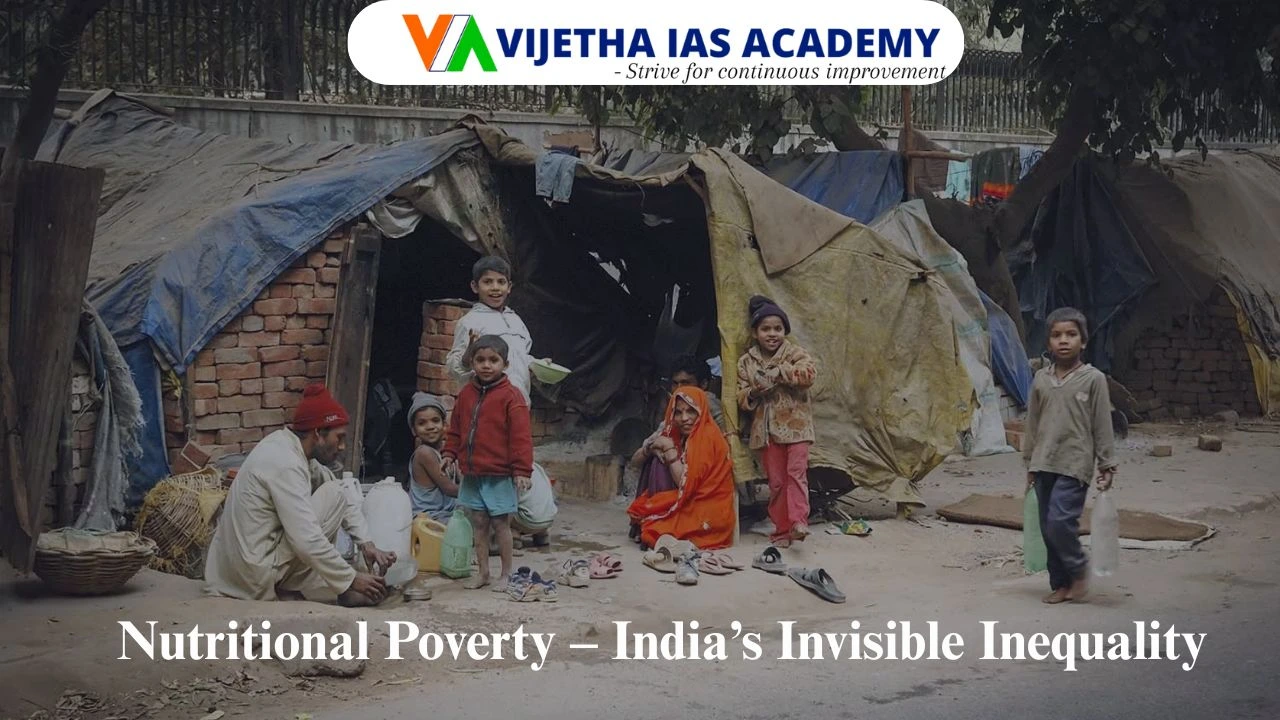
Nutritional Poverty – India’s Hidden Inequality
Understanding the Concept
India’s story of development often celebrates the reduction of income poverty. Yet, beneath this progress lies an invisible crisis — nutritional poverty. It is not just about having food to eat, but about what kind of food people eat. While millions consume enough calories, many are deprived of essential nutrients, including proteins, vitamins, and minerals.
This is the paradox of modern India — where economic growth coexists with widespread nutritional deprivation. The poor suffer from lack of access to balanced diets, while the rich suffer from lack of awareness about healthy eating habits.
From Income Poverty to Nutritional Poverty
Over the last three decades, India has lifted millions above the poverty line. However, the problem of nutritional poverty persists, cutting across classes and regions. Health data reveals the grim truth:
- Global Hunger Index 2024: India ranks 102 out of 123 countries.
- NFHS-5 (2019–21): 33% of children are stunted, 19% wasted, and nearly 20% of women are anaemic.
Simultaneously, obesity and related diseases are rising among the urban middle class. Around 24% of women and 23% of men are now overweight or obese. India faces a double burden — undernutrition among the poor and overnutrition among the rich.
Why Does Nutritional Poverty Exist?
1. Poverty of Access
The poor cannot afford nutrient-rich foods like fruits, pulses, or milk. Public schemes like PDS mainly provide rice and wheat, which fill stomachs but not bodies with nutrients.
2. Poverty of Awareness
Among the middle and upper classes, the problem lies in ignorance. Fast food culture, digital advertisements, and online delivery platforms promote high-sugar and high-fat diets. This marks a shift from traditional Indian diets to ultra-processed industrial foods.
3. Policy Gaps
Government schemes such as ICDS and Poshan Abhiyaan focus largely on mothers and children, overlooking adult nutrition. Millets, once a staple of Indian diets, were neglected in favour of cereals. Fortunately, with the UN declaring 2023 as the International Year of Millets, awareness is slowly returning.
Educational and Cultural Factors
In India, food is often seen as a symbol of comfort or social status rather than a means of nourishment. Schools rarely teach nutrition science, and even doctors receive little formal training in dietary counselling. The result — even wealthy families lack dietary diversity.
A recent comparison of Indian diets with the EAT-Lancet reference diet found that most households consume too many cereals and too few proteins, fruits, or vegetables. This imbalance leads to poor health outcomes across all income levels.
Human and Economic Costs
The consequences of nutritional poverty are not limited to health; they extend to the economy. Poor diets lead to rising cases of non-communicable diseases like heart disease, diabetes, and hypertension. These conditions push families into a vicious cycle — disease, medical expenses, debt, and further decline in food quality.
By 2030, diet-related illnesses could cost India nearly ₹382 lakh crore in lost productivity and healthcare expenditure. Shockingly, less than 2% of India’s health budget goes to nutritional and preventive healthcare.
The Way Forward: From Feeding to Educating
True reform lies in transforming India’s food system from subsidy-driven to knowledge-driven.
Some key measures include:
- Integrating nutrition counselling into every Primary Health Centre.
- Introducing nutrition education in school curricula.
- Training healthcare workers in diet and lifestyle management.
- Promoting food literacy apps that encourage healthy local diets.
- Coordinating between agriculture, health, and education ministries to promote millets and local produce.
India must move from food security to nutritional justice. Real development is not about ensuring that people are merely fed, but that they are well nourished.