
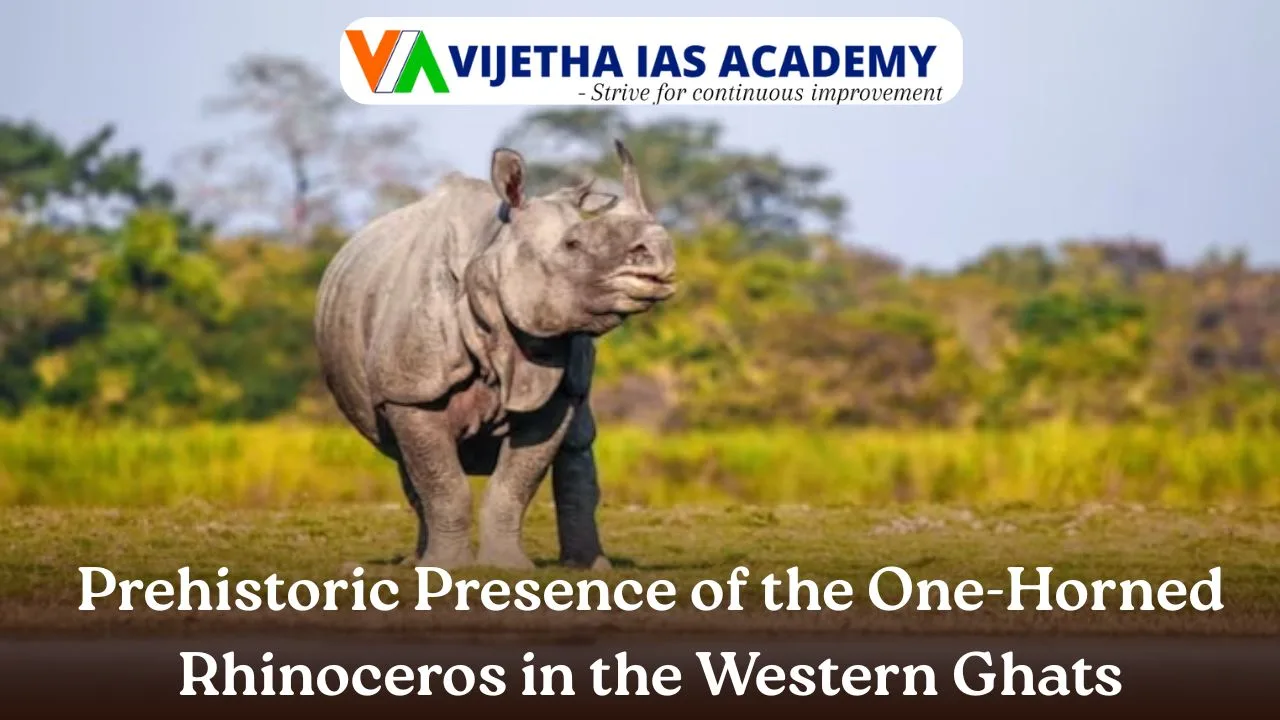
Prehistoric Presence of the One-Horned Rhinoceros in the Western Ghats
Introduction
Archaeological discoveries often challenge our understanding of past environments and human–animal relationships. The discovery of 3,500-year-old remains of the Indian one-horned rhinoceros at Molapalayam near Coimbatore has significantly altered perceptions of India’s prehistoric ecology. This case study is highly relevant to Archaeological Anthropology under Paper I, linking material evidence with environmental reconstruction.
The Archaeological Discovery
Excavations at the Molapalayam Neolithic site revealed four bone fragments belonging to the Indian one-horned rhinoceros, dated to 1600–1400 BCE using radiocarbon techniques. This is a rare find and one of the very few instances of rhino remains discovered in southern India.
Reconstructing the Prehistoric Environment
The presence of rhino remains suggests that the foothills of the Western Ghats once supported:
- Extensive grasslands
- Marshes and wetlands
- Reliable water sources
Such conditions were suitable for large, water-dependent grazers like rhinos, indicating a far richer ecosystem than what exists today in the region.
Human–Animal Interaction
The rhino bones were found alongside remains of domesticated animals and wild species. This indicates:
- Mixed subsistence strategies involving pastoralism and hunting
- Coexistence of humans and megafauna
- Limited ecological pressure compared to modern times
Over centuries, agriculture expansion, urbanisation, and habitat loss likely led to the disappearance of rhinos from southern India.
Contemporary Conservation Insights
Today, the one-horned rhino is confined mainly to Assam and Nepal. The Molapalayam discovery shows that current species distribution is historically contingent and shaped by long-term human activity. It reinforces the importance of grasslands and wetlands in conservation planning.
Anthropological Importance
- Zooarchaeology: Helps reconstruct prehistoric biodiversity
- Human–Environment Interaction: Shows how ecosystems change with human intervention
- Applied Anthropology: Archaeology informing modern conservation policy
Conclusion
The Molapalayam rhino discovery reshapes understanding of India’s ecological past and highlights the dynamic relationship between humans, animals, and environments. It serves as a powerful case study demonstrating how archaeological evidence informs anthropology, ecology, and sustainable development debates.