
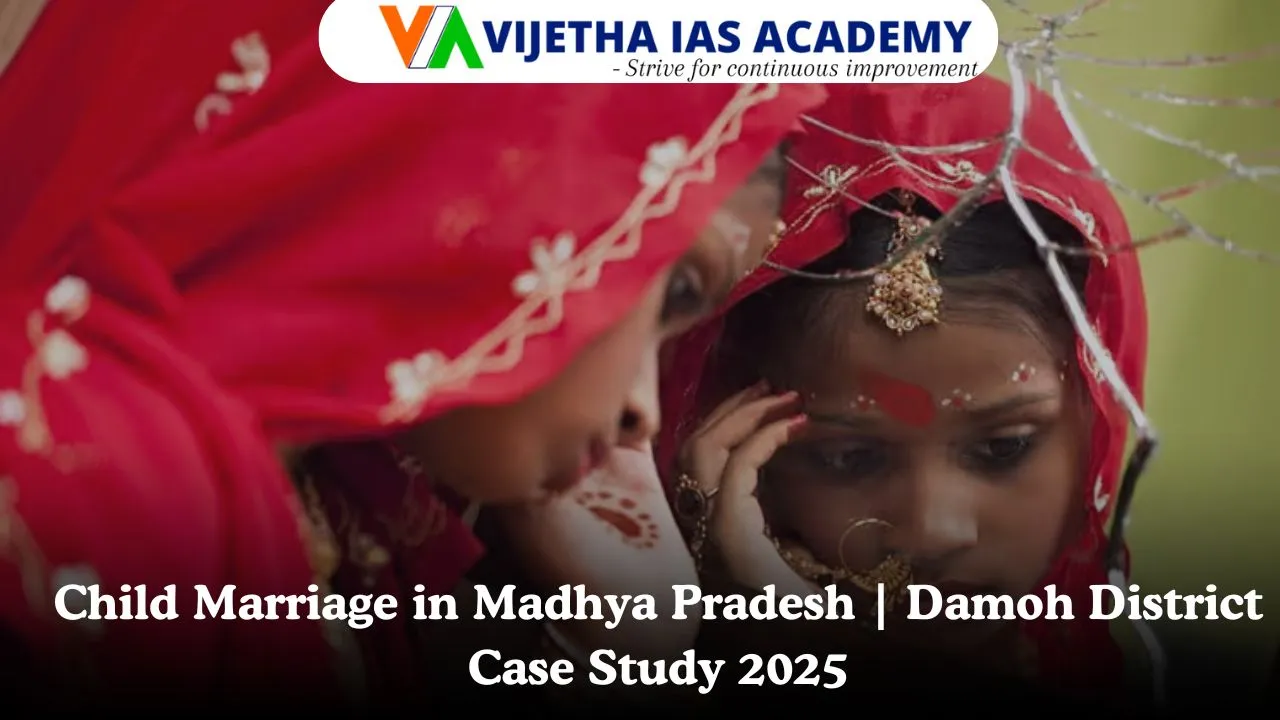
Rising Child Marriages in Madhya Pradesh: The Damoh District Challenge
Introduction
Child marriage continues to be one of India’s most serious social challenges, affecting education, health, gender equality, and human rights. Despite strict laws and awareness campaigns, several regions still see a rise in such cases. In 2025, Madhya Pradesh reported a 47% spike in child marriages since 2020. The biggest alarm came from Damoh district, which recorded 115 cases in a single year. This article examines why child marriages persist and what can be done to stop them.
Background
- Madhya Pradesh recorded 538 cases of child marriage in 2025.
- Damoh alone contributed 21% of these cases.
- The Prohibition of Child Marriage Act (2006) exists, but implementation is weak.
- Social pressures, poverty, and lack of education continue to drive the practice.
Who Are the Main Stakeholders?
- Girls facing loss of schooling and health risks
- Families and community elders following harmful traditions
- District administration (police, CMPOs, Collector)
- Government departments (WCD, Education, Health)
- NGOs and frontline workers
- State government for monitoring and policy
Why Child Marriage Continues (Key Issues)
- Poverty and economic insecurity
- Patriarchal norms and "honour" concerns
- High dropout rates among girls
- Weak enforcement by local authorities
- Low coordination across departments
- Reactive governance — action only after marriage happens
Ethical & Governance Concerns
- Violation of bodily autonomy
- Gender injustice
- Failure of public institutions
- Conflict between cultural practices and constitutional rights
Major Administrative Gaps
- CMPOs lack staff and resources
- Awareness drives not backed by enforcement
- No real-time data alerts
- Poor involvement of communities and religious leaders
6. What Can Be Done? (Way Forward)
Short-Term Solutions
- Track hotspot villages
- Strengthen CMPO accountability
- Mandatory registration of marriages
- Engage teachers, ASHA, Anganwadi workers as informants
Medium-Term Solutions
- Scholarships & incentives to keep girls in school
- Livelihood schemes for poor families
- Engage religious/community influencers
- Build adolescent girls’ groups
Long-Term Structural Changes
- Women’s economic empowerment
- Integrate health, nutrition, education & policing
- Behaviour change campaigns
- Regular performance audits of district officers
Expected Impact
If effectively implemented:
- Child marriage rates decline
- Girls stay in school longer
- Governance becomes more responsive
- Gender equality improves
- SDG goals related to gender and justice are strengthened
Conclusion
The Damoh case makes one thing clear: child marriage is not just a legal issue—it is a deep-rooted social problem. Laws help, but only when backed by local enforcement, education, economic empowerment, and community support. Ending child marriage is essential for building an India where every girl can grow, learn, and live with dignity.