
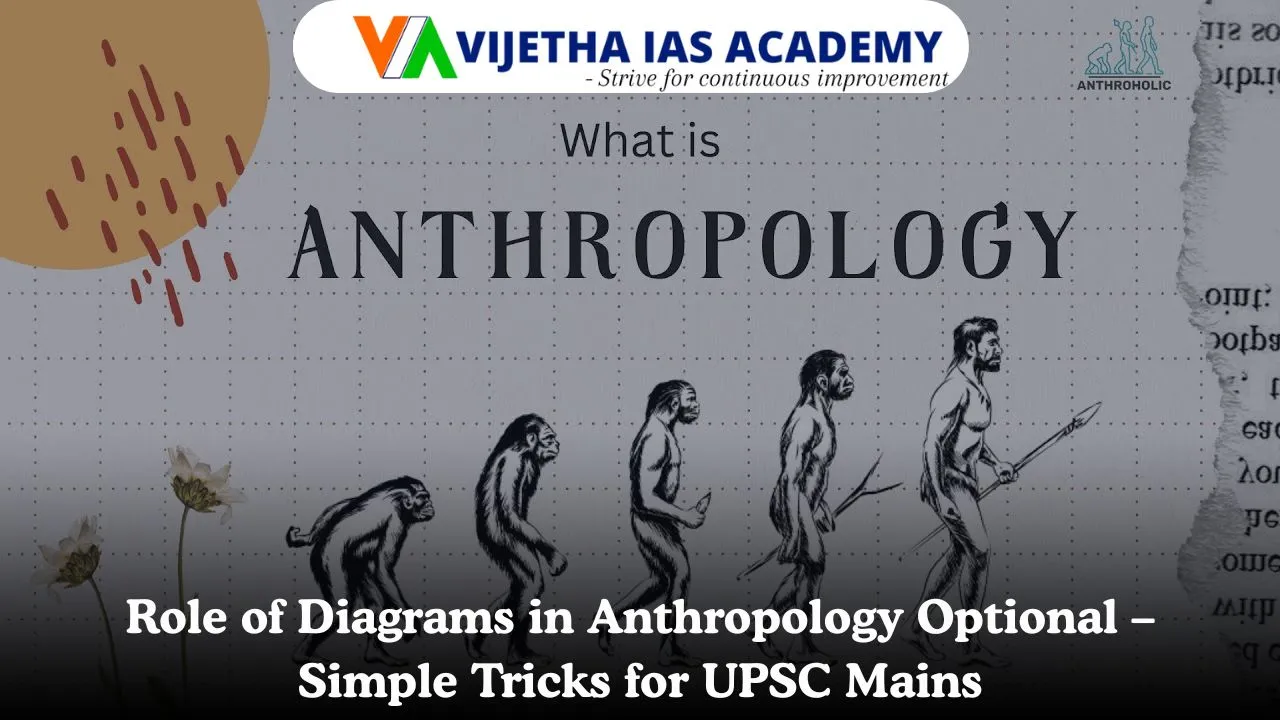
Role of Diagrams in Anthropology Optional – Simple Tricks for UPSC Mains
If there is one thing that separates Anthropology Optional from many other subjects in UPSC Mains, it is the power of diagrams. For many toppers, diagrams serve as a scoring tool, time-saving technique, and a clarity-enhancing method—all at the same time.
Whether it is Physical Anthropology, Social Anthropology, Tribal India, Genetics, Evolution, or Research Methods, diagrams make your answers sharp, neat and examiner-friendly.
Why Diagrams Matter in Anthropology Optional
Anthropology is a subject that blends science, art, and social sciences. Examiners appreciate answers that are:
✔ Easy to understand
✔ Structured
✔ Supported with visuals
Here’s why diagrams help you score more:
1. Quick Impression on the Examiner
When a paper checker opens your answer booklet, diagrams immediately stand out. They show clarity and confidence. Toppers often say that even if the content is average, diagrams uplift the answer quality.
2. Saves Time During Writing
Instead of writing long paragraphs about skull types, human evolution, blood group inheritance, kinship charts or Nuer lineage systems, a quick diagram communicates everything in seconds.
3. Shows Conceptual Clarity
Anthropology is technical in many areas. Diagrams prove that you understand:
- anatomical structures
- evolutionary trends
- kinship relations
- demographic patterns
- tribal settlement types
- social stratification
4. Helps in Both Paper I & Paper II
Many aspirants think diagrams are useful only for Physical Anthropology. But diagrams also make Social Anthropology expressive—for example:
- tribe-caste continuum
- kinship maps
- village structure
- ritual cycles
- social change models
5. Higher Chance of Crossing 140+
One key trait of high scorers (260–300 range) is consistent use of diagrams across both papers.
Where to Use Diagrams in Anthropology Optional
You should not wait for “diagram-based questions.” Almost every topic can be supported with visuals.
Diagrams for Paper I
- Human Evolution – skull comparison, brain size chart, posture diagrams
- Genetics – Mendelian cross, gene flow, Hardy-Weinberg curve
- Osteology – long bone structure, dental formula
- Primates – skeletal differences between ape-human
- Blood Groups – population distribution graphs
- Anthropometry – cephalic index diagrams
- Serology & Forensics – fingerprint patterns
Diagrams for Paper II
- Kinship – descent systems, alliance patterns, lineage diagrams
- Tribal Studies – settlement patterns, ecological zones, economy charts
- Caste System – hierarchy models
- Village Studies – land distribution maps
- Social Change – Sankritisation cycle, Westernisation process flow
- Development Anthropology – project cycle models
The more visual your answer, the more marks you attract.
Simple Tricks to Draw Diagrams
1. Use Boxes, Circles, Arrows
Most Social Anthropology diagrams can be drawn using just:
- boxes
- straight lines
- arrows
- simple circles
- stick figures
Example: a kinship diagram does not require artwork—simple symbols are enough.
2. Label Clearly
A simple diagram with proper labels scores better than a detailed diagram with no labels.
3. Always Draw on the Right Side
Place diagrams on the right margin of your answer sheet. It makes the answer visually balanced.
4. Use Very Small Space
Avoid large diagrams. They should be compact and relevant.
5. Practice 10 Diagrams Daily
In 60 days, you can master 600 diagrams.
This dramatically improves speed and neatness.
6. Have a Ready List of 50 Must-Use Diagrams
Every anthropology optional coaching institute recommends this.
Keep diagrams ready for:
- Australopithecus
- Homo erectus
- Mendelian genetics
- Kinship
- Tribe–caste continuum
- Sacred complex
- Village studies schema
7. Add a Diagram in Every Long Answer
Even if the question is theoretical, a small diagram boosts your marks.
8. Combine Diagrams + Flowcharts
Hybrid visuals are powerful, especially for 20-mark answers.
Examples of High-Scoring Diagrams
Here are examples of diagrams that add value instantly:
1. Evolution of Hominids
A simple side-view sketch of:
Australopithecus → Homo habilis → Homo erectus → Neanderthal → Homo sapiens
With brain size annotations.
2. Tribal Settlement Pattern
A top-view sketch showing:
- central dancing ground
- clan clusters
- headman house
3. Kinship System
Circles = females
Triangles = males
Horizontal lines = marriage
Vertical lines = descent
4. Social Change Model
A simple arrow flowchart:
Tradition → Change Agent → Resistance → Adaptation → New Social Order
Such visuals leave a strong effect.
FAQs on Diagrams in Anthropology Optional
1. Do diagrams really increase marks in Anthropology Optional?
Yes. Almost all toppers emphasise that diagrams help you score higher because they make answers neat, clear and examiner-friendly.
2. Do I need to draw diagrams in Paper II also?
Absolutely. Even in Social Anthropology, diagrams such as kinship charts and social change models add value and fetch more marks.
3. What if I am not good at drawing?
No problem. UPSC expects clean and simple diagrams—not artistic drawings. Practice using basic shapes.
4. How many diagrams should I draw in a 20-mark question?
Ideally 1 main diagram and 1 small supporting diagram.
5. Should diagrams be coloured?
No. Only use a black pen. Colouring is unnecessary.
6. How can I practise diagrams effectively?
Create a diagram bank of 50–60 diagrams and revise them frequently. Many students also use anthropology coaching online platforms for diagram practice.
7. Can diagrams replace explanation?
No. They support the explanation but cannot replace your conceptual clarity. Write 3–4 lines after each diagram.