
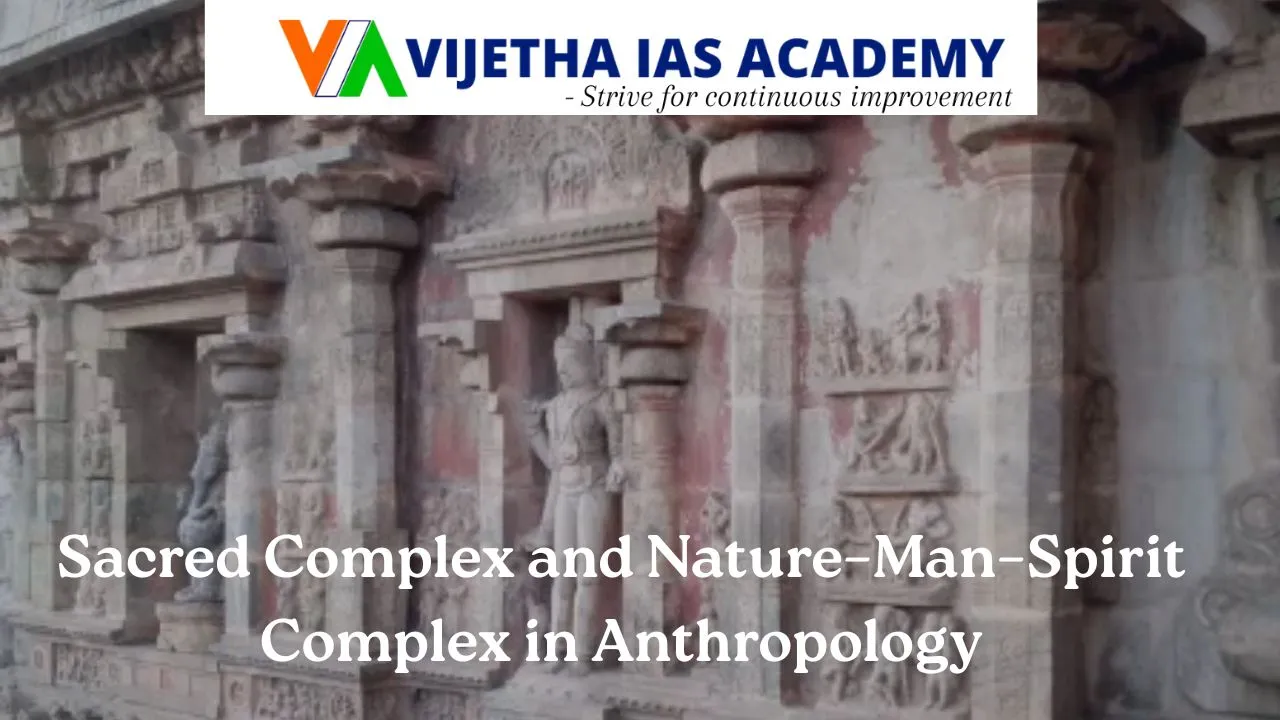
Sacred Complex and Nature–Man–Spirit Complex in Anthropology
The study of Sacred Complex and Nature–Man–Spirit Complex is an important part of Anthropology Optional for UPSC Mains (Paper II). Both concepts were introduced by L.P. Vidyarthi, the father of applied anthropology in India. His work provides valuable insights into Indian society, cultural traditions, and ecological adaptations, making these theories crucial for Anthropology students and UPSC aspirants.
Sacred Complex
The term Sacred Complex was introduced by L.P. Vidyarthi after his detailed study of Bodh Gaya in Bihar. He analyzed how sacred centers function as cultural hubs by integrating rituals, specialists, and geography.
Three Aspects of the Sacred Complex:
- Sacred Geography – Spatial organization of a sacred city into zones, clusters, segments, and centers. A sacred center may be a temple, river, tree, or image of a deity, acting as the smallest unit of worship.
- Sacred Performances – Religious activities such as poojas, yajnas, yagas, homas, bhajans, keertanas, and recitations that keep traditions alive across time and space.
- Sacred Specialists – Priests, astrologers, palmists, singers, dancers, barbers, and saints who conduct and assist in rituals.
Significance of Sacred Complex:
- Explains cultural complexity and continuity of great and little traditions.
- Highlights the role of pilgrim centers in preserving traditions.
- Shows how religious spaces contribute to integration, enculturation, and cultural survival.
- Sacred centers act as cultural universities, spreading spirituality, morality, and charity across India.
Nature–Man–Spirit Complex
Another important contribution of L.P. Vidyarthi is the Nature–Man–Spirit Complex, based on his study of the Maler tribe in Rajmahal Hills, Jharkhand.
Key Features:
- Human life is deeply connected with the local environment.
- Culture is a response to ecological conditions, and adaptation patterns vary from one region to another.
- Tribal economic, social, and spiritual life revolves around nature and ecology.
Components of the Complex:
- Nature – Activities like food gathering, hunting, and shifting cultivation.
- Man – Institutions such as marriage, family, and kinship.
- Spirit – Beliefs in good and bad spirits.
Among the Maler tribe, good spirits ensure health, fertility, and prosperity, while bad spirits are linked to sickness, death, and disasters. All spirits are believed to be under the control of a head ghost called Gosain, who acts as the mediator between humans, nature, and spirits.
Importance for UPSC Aspirants
These two concepts not only highlight India’s cultural diversity and ecological adaptation, but also show how traditions, beliefs, and rituals are interconnected. For Anthropology optional, understanding these theories helps candidates write analytical answers in UPSC Mains, linking theoretical knowledge with case studies.
Call to Action
If you are preparing for UPSC Anthropology Optional, mastering topics like the Sacred Complex and Nature–Man–Spirit Complex is crucial for scoring 300+ in Mains.
Join Vijetha IAS Academy, one of the Best Anthropology optional Coaching Delhi, for:
- Anthropology Optional Classroom Coaching by expert faculty N.P Kishore Sir.
- Anthropology Optional Test Series 2025, designed to sharpen your answer-writing skills.
- Personalized mentorship and detailed feedback to maximize your score.
Take the next step in your UPSC journey with Vijetha IAS Academy’s Anthropology Courses and Test Series.
Contact us today at 9494845845 or visit vijethaiasacademy.com.