
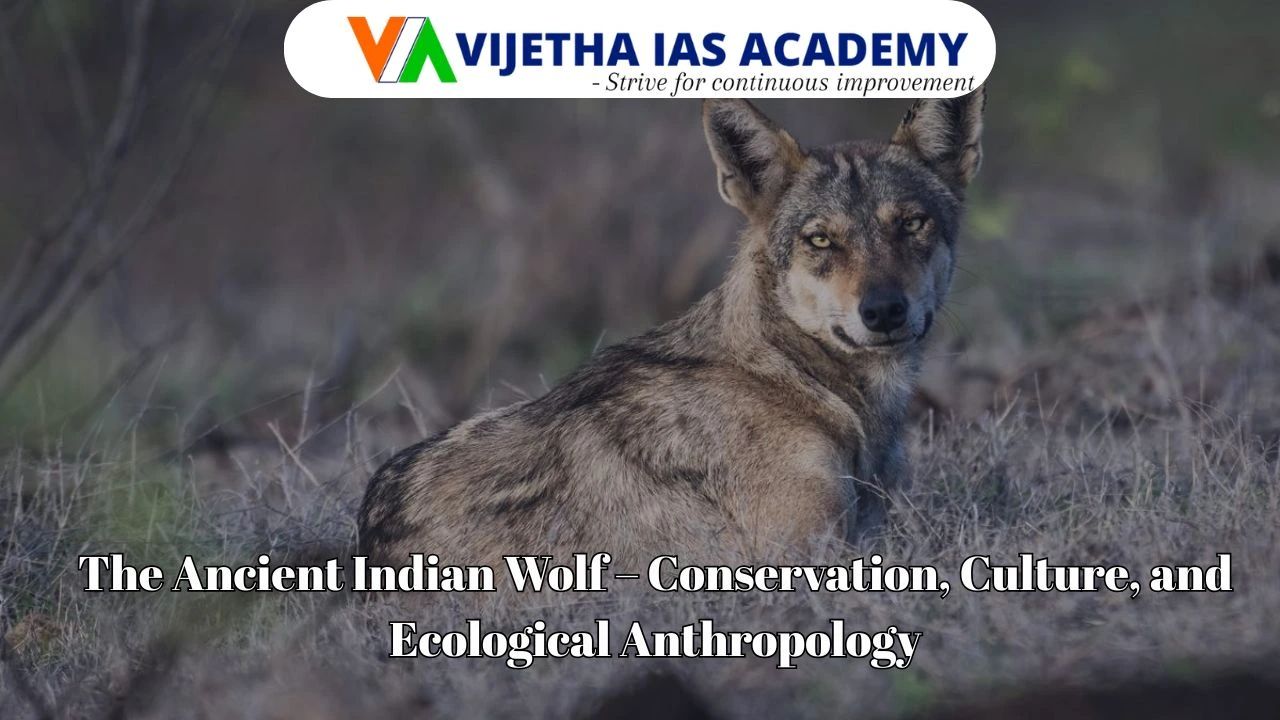
The Ancient Indian Wolf – Conservation, Culture, and Ecological Anthropology
Introduction
The Indian wolf (Canis lupus pallipes) is one of India’s most ancient and mysterious predators. New genetic research reveals that it represents the oldest living wolf lineage in the world, distinct from the global grey wolf. This discovery highlights not only a biological milestone but also an anthropological one—showcasing how humans and ecosystems are interlinked through evolution, culture, and conservation.
This topic falls under Ecological Anthropology (Paper I 9.7), exploring how humans interact with their natural surroundings and the socio-cultural aspects of environmental conservation.
Current Status and Habitat
- IUCN Red List: Vulnerable
- Estimated population: ~3,000 individuals (India and Pakistan)
- Habitat: Semi-arid grasslands and scrublands—often labelled as “wastelands”
Ironically, these very ecosystems are vital for maintaining biodiversity. Yet, they remain neglected in developmental policies.
Major Threats to Survival
- Habitat Loss: Conversion of grasslands for solar farms, industries, and highways has destroyed den sites (e.g., Kutch, Gujarat).
- Decline in Prey Base: Overgrazing and human encroachment reduce prey species, forcing wolves to attack livestock.
- Retaliatory Killings: Local communities poison or kill wolves in response to livestock losses.
- Hybridisation with Feral Dogs: Leads to genetic dilution and disease transmission (like rabies).
- Human-Wolf Conflict: Scarcity of prey drives wolves near settlements, resulting in violent reprisals.
Conservation and Policy Implications
Recognition of the Indian wolf as a distinct species could transform conservation efforts:
- It may attract international research and funding, highlighting India’s evolutionary heritage.
- Under Schedule I of the Wildlife Protection Act (1972), the species already enjoys high protection—but enforcement remains weak.
- Experts suggest moving beyond “protected areas” and developing coexistence models with rural communities.
India also needs a National Action Plan for wolf conservation—integrating habitat restoration, community awareness, and conflict mitigation.
Anthropological Interpretation
Ecological anthropology emphasises that wildlife conservation is not just science—it’s a cultural phenomenon. Traditional communities living near wolves have long practiced coexistence through folklore and land-use ethics. However, modernization has disrupted these patterns, replacing harmony with hostility.
Re-evaluating grasslands as productive ecosystems rather than wastelands is both an ecological and cultural necessity. This approach aligns with India’s Anthropocene challenges—where human activity reshapes nature itself.
Way Forward
- Reclassify grasslands for ecological protection
- Introduce compensation schemes for livestock losses
- Promote grassland restoration through eco-development programs
- Foster scientific research and global collaboration
FAQs
Q1. Why is the Indian wolf considered unique?
It’s genetically distinct and represents the most ancient wolf lineage globally.
Q2. How can local communities help in conservation?
Through awareness, livestock protection measures, and coexistence-based eco-tourism initiatives.
Q3. What role does anthropology play here?
Anthropology helps understand human–wildlife relationships, local perceptions, and sustainable coexistence strategies.
Call to Action
At Vijetha IAS Academy, students of anthropology optional UPSC gain deep insights into ecological issues like this. Our anthropology coaching online and offline programs train aspirants to connect science, culture, and sustainability — a vital skill for UPSC Mains.
Join Vijetha IAS Academy, the best anthropology coaching online, and learn how Anthropology shapes environmental understanding and policy action.