
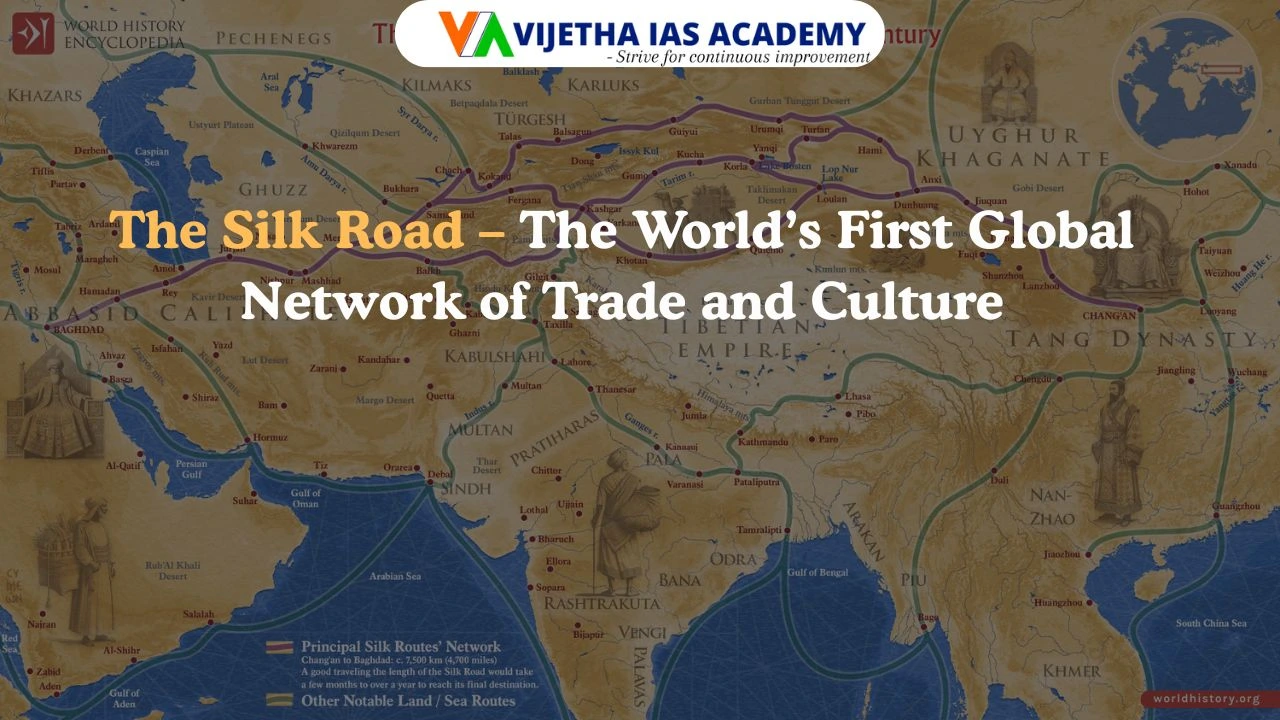
The Silk Road – The World’s First Global Network of Trade and Culture
(Paper I: Social-Cultural Anthropology)
A Road that Changed the World
Centuries before airplanes and the internet, there was the Silk Road — a vast network of land and sea routes connecting China, India, the Middle East, Africa, and Europe.
From the 2nd century A.D. to the 15th century, it became the lifeline of ancient globalisation, carrying not just silk and spices but also ideas, art, science, and religion.
Though the term “Silk Road” was coined in 1877 by a German explorer, modern historians prefer “Silk Routes” — to reflect its many interconnected pathways.
The Structure of the Silk Road
The Silk Road was not one continuous road, but a web of trade routes:
- Land Corridors: From Xi’an (China) through Central Asia and Afghanistan to the Mediterranean and Roman Empire
- Maritime Routes: From Southeast Asia to Sri Lanka, South India, the Arabian Sea, and beyond to Africa and Europe
Together, these routes linked diverse civilisations and turned Eurasia into a shared cultural and economic zone.
What the World Traded
The Silk Road carried luxury goods as well as daily commodities:
- From China: Silk, porcelain, paper, tea
- From India: Spices, sandalwood, textiles, ivory, and gems
- From the West: Gold, glassware, olive oil, horses, and furs
This exchange gave rise to vibrant trading hubs like Samarkand and Kashgar, and helped cities prosper across Asia and Europe. Merchants gained wealth and prestige, forming an early version of a global economy.
Exchange of Ideas and Cultures
Trade was only one part of the story. The Silk Road also carried knowledge, faith, and art across continents:
- Religions: Buddhism spread from India to China; Islam reached Southeast Asia; Christianity moved eastward.
- Technology: Paper-making and gunpowder from China reached Europe; glass-making and metalwork moved east.
- Science: Astronomy, medicine, and mathematics travelled across borders.
- Art: Fusion styles like Gandhara art beautifully combined Greek and Indian influences.
- Languages: Persian, Sanskrit, Arabic, and Chinese became bridges of communication.
This rich cultural interaction made the Silk Road a true symbol of human unity.
Economic and Political Impact
Empires from the Han Dynasty to the Romans benefited immensely. Trade led to diplomatic relations, political stability, and economic prosperity.
During the Mongol Empire, the Silk Road reached its golden age — a period known as Pax Mongolica, when the routes were safe, trade flourished, and ideas travelled freely.
Challenges and Decline
Despite its glory, the Silk Road faced major difficulties:
- Harsh deserts, mountains, and unpredictable weather
- Attacks by bandits and pirates
- Political conflicts between empires
- The Black Death (14th century) spread along the trade routes, leading to huge population losses
Eventually, in the 15th century, the rise of sea-based trade and the fall of the Mongol Empire caused the Silk Road to decline.
Legacy in the Modern World
The Silk Road never truly disappeared — its spirit of connection still shapes the modern world.
- Culturally, it influenced art, music, and cuisine.
- Economically, it laid the foundation for international trade and diplomacy.
- Institutionally, UNESCO’s Silk Roads Programme promotes cultural dialogue.
- Modern Revivals: China’s Belt and Road Initiative (BRI) and India’s Chabahar Port project continue the legacy of global cooperation.
Lessons for Today
- Exchange leads to growth, isolation leads to decline.
- Diversity is strength — the Silk Road united cultures, not divided them.
- Reflects India’s timeless philosophy of Vasudhaiva Kutumbakam — “The world is one family.”
- Reminds us that global progress must be balanced with sustainability, peace, and mutual respect.
Conclusion
The Silk Road was more than a trade route — it was a bridge of humanity. It linked people, economies, and ideas across thousands of miles, proving that cooperation creates prosperity.
In a world once again striving for global harmony, the Silk Road’s story teaches us that connectivity, dialogue, and understanding are the true paths to progress.