
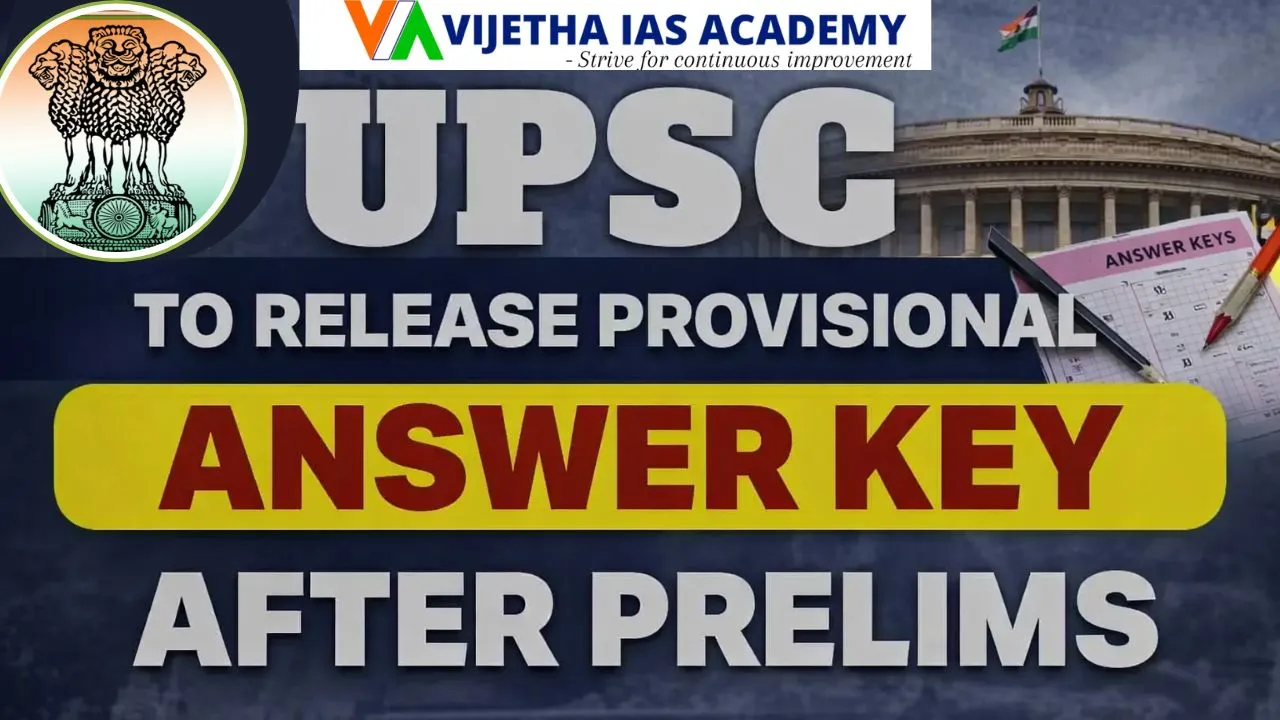
UPSC to Release Provisional Answer Key After Prelims 2026
Introduction
The Union Public Service Commission (UPSC) has introduced a landmark reform in the Civil Services Examination (CSE) process. Starting from UPSC Prelims 2026, the Commission will release a provisional answer key shortly after the Preliminary Examination.
This decision marks a significant shift towards greater transparency, fairness, and accountability, benefiting lakhs of aspirants preparing for one of India’s toughest examinations.
Every year, nearly 12 lakh candidates appear for UPSC Prelims, and this reform will fundamentally improve how candidates evaluate their performance and prepare for the next stage — the UPSC Mains Examination.
UPSC Provisional Answer Key 2026 – What’s New?
Earlier, UPSC used to release the official answer key only after the final result, leaving candidates waiting for months. However, under the new system:
- The provisional answer key will be released immediately after Prelims
- Only candidates who appeared in the exam can access it
- Candidates can raise objections with valid proof
- A final answer key will be prepared after expert review
Old vs New System
|
|
|
|
|
|
|
|
|
|
|
|
|
|
|
|
|
|
|
|
Role of the Supreme Court in This Reform
The reform was influenced by a key intervention from the Supreme Court of India, which emphasized the need for transparency in competitive examinations.
Background
- Petitioners challenged UPSC’s practice of delayed answer key release
- They argued that it prevented candidates from evaluating their performance
Key Developments
- The Court appointed an Amicus Curiae (legal advisor) to study the issue
- Experts recommended releasing a provisional answer key after Prelims
- Initially, UPSC resisted citing logistical concerns
Final Outcome
In September 2025, UPSC agreed to adopt the new system, making this a historic reform in the examination process.
Key Features of UPSC Answer Key Reform 2026
1. Early Release of Answer Key
Candidates will no longer have to wait months. The provisional key will be available within days of the exam.
2. Objection Window for Candidates
- Only genuine candidates can raise objections
- Helps maintain credibility and seriousness in the process
3. Mandatory Supporting Evidence
Each objection must include at least three standard references such as:
- NCERT books
- Standard textbooks
- Government sources
4. Expert Committee Review
A panel of subject experts will:
- Verify objections
- Evaluate sources
- Finalize correct answers
5. Final Answer Key Publication
The final answer key will still be released after the complete exam cycle, maintaining UPSC’s traditional practice.
Step-by-Step Process to Raise Objections
Step 1: Release of Provisional Key
UPSC will upload the answer key on its official website.
Step 2: Opening of Objection Window
Candidates can log in and access the objection portal.
Step 3: Submission of Objections
- Mention question number
- Provide correct answer
- Attach valid references
Step 4: Expert Evaluation
Subject experts will review all valid objections carefully.
Step 5: Final Result Preparation
The corrected answer key will be used to prepare the Prelims result.
Check this-Prelims Revision Plan 2026 – UPSC Prelims Strategy & Study Plan
Impact of UPSC Answer Key Reform on Aspirants
1. Faster Performance Evaluation
Candidates can:
- Calculate scores early
- Analyse mistakes
- Plan for Mains preparation effectively
2. Reduced Confusion
No more reliance on coaching answer keys or unofficial sources.
3. Increased Transparency
The evaluation process becomes more open and trustworthy.
4. Fair Opportunity to Challenge Errors
Candidates now have a structured way to:
- Raise objections
- Correct genuine mistakes
5. Fewer Legal Disputes
With transparency and early clarification:
- Litigation will reduce
- Results will be smoother and faster
Challenges in Implementation
While the reform is progressive, it comes with certain challenges:
1. Handling Large Number of Objections
With lakhs of candidates, managing objections can be complex.
Solution: Introduce a nominal fee or limit the number of objections.
2. Ensuring Quality References
Not all submitted sources may be reliable.
Solution: UPSC can release a list of accepted standard sources.
3. Maintaining Speed and Accuracy
Balancing quick evaluation with correctness is crucial.
Solution: Use expert panels and digital tools for faster processing.
4. Preventing Misuse
Some candidates may file unnecessary objections.
Solution: Restrict the number of objections per candidate.
Check this- Prelims Preparation
Why This Reform is a Game-Changer
The UPSC Provisional Answer Key Reform 2026 is a major milestone in India’s examination system. It:
- Empowers candidates
- Improves transparency
- Builds trust in the system
- Aligns UPSC with global best practices
For serious aspirants, this reform will transform preparation strategy, especially between Prelims and Mains.
Conclusion
The decision by UPSC to release a provisional answer key after Prelims is a welcome and much-needed reform. It ensures fairness, enhances accountability, and gives aspirants a clear understanding of their performance.
At Vijetha IAS Academy, we believe this change will help students adopt a smarter, more analytical approach to UPSC preparation. With the right guidance, timely evaluation, and structured mentorship, aspirants can significantly improve their chances of success.
FAQs
1. When will UPSC release the provisional answer key?
UPSC will release it soon after the Prelims exam, starting from 2026.
2. Can all candidates raise objections?
No, only candidates who appeared for the exam can submit objections.
3. Is there any proof required for objections?
Yes, candidates must provide at least three credible sources.
4. Will the final answer key still be released?
Yes, UPSC will continue releasing the final answer key after the final result.
5. How will this reform help aspirants?
It will provide early evaluation, transparency, and a fair chance to correct errors.